Posts
Ten Features of World Class Development Programs
The times are changing but…
While our world is changing rapidly, it could be argued that our management practices have not kept pace with these changes. In fact, I think we’re trailing badly.
In reality not much has changed in 100 years. The training and development industry largely rehashes old theory and practices and makes the same mistakes. At the most fundamental level however, our overall quality of management and leadership is poor and is based on archaic notions based on the industrial age.
“We should stop trying to make people happy and instead make them better equipped to deal with the challenges of today’s organisations.”
While more than 75% of learners report high levels of satisfaction with learning programs, in our heart of hearts we know that there is no correlation between ‘happy sheets’ and the successful application of program learning and subsequent performance. We should stop trying to make people happy and instead make them better equipped to deal with the challenges of today’s organisations.
We think we’re driving a Ferrari but we’re really driving a vehicle from the 1900’s…
Our Top 10 Features / Practices
Our research and practice in learning and development over two decades has allowed us to assemble a ‘top 10’ list that all development programs should at least consider integrating. I’m not suggesting that programs should have all ten, although that goal is certainly achievable (see Actionable Conversations for example). Programs that manage to incorporate many of the practices are more likely to be effective, sustainable and cost-effective.
So here are our top 10….
1. Solid context
Ensure that programs are framed and positioned in a strong context that includes an assessment of the market / external environment, strategy, the customer and the organisation’s vision for the future. Only then can an organisation determine the type of leader it needs and therefore the type of program it should invest in. We should dispense with generic competency based models and generic programs that are not targeted.
2. Just-in-time & strategic
If point #1 is true (above), it also holds true that training should be more agile, responsive and ‘just-in-time’ to meet the specific development needs now and in the short-term. Too often organisations get caught in the trap of looking too far in to the future to try to determine leadership needs. A more pertinent question is to ask ‘What do we need right now and in the coming 12 months?’
3. Leader-led / expert-driven
Developing people should be led internally – harvesting every opportunity, everyday. This should be a blend of informal in-the-moment; semi-structured (e.g. monthly leader-led conversations around a mission critical theme); or more formal training provided by outside experts who can bring a perspective and skills sometimes not present internally.
“Developing people should be led internally – harvesting every opportunity, everyday.”
4. Real-world & practical
Please don’t read ‘real-world’ and practical as just being focused on skill building or superficial training that doesn’t challenge people around their mindsets and behaviours. The most effective development programs invite people to play at their edge. The best programs are transformational, where participants can never view themselves or the world in the same way again (the ANZ Breakout program was a good example of this where I was the head of program delivery between 2001 and 2007).
5. Transfer of learning is primary
Learning can suffer three fatal flaws: (1) it occurs in a vacuum; (2) is not linked to a learner’s role or business unit objectives or (3) learning remains in the classroom. Research tells us that the most important factor in program participants being able to apply their learning back in the workplace is their manager.
6. Supports both leader and learner
We tell our program participants that their 1-up manager should almost feel like they’re going through the program, such should be the level of communication, sharing and support that happens in that relationship. Unfortunately this is more aspirational than fact. Secondly, programs that are leader-led have the added benefit of developing both the team member as well as the leader running the session.
7. Mechanisms to support accountability
I like to call this the ‘scaffolding’ that helps support learners. Examples include regular development meetings with their manager; scheduling time for reflection on behaviours and approach; formal or informal coaching / mentoring; and perhaps most importantly, developing habits and practices (see # 9).
8. Doesn’t break the bank
This perhaps goes without saying, however if programs are going to be rolled out in large volume then they need to be cost-effective and provide a measurable return-on-investment.
9. Focuses on the pathway to get there
One observation I have made repeatedly is that we over-invest in goal setting and under-invest in the pathways to get there. In other words, you can set all the goals you want, but if you don’t have a plan to get there, the goals are useless. And the pathway to get there is through developing habits and practices that move you toward the goal everyday. Read my post on LinkedIn on Habits and Practices.
10. Reinforced & Rewarded
Accountability is an over-used word in organisations, however if you want people to do something different, there has to be accountability built in to development programs. Also, we are all human. In a world that is quick to criticize or cut-down, the basic human need of support and acceptance is enduring. Reward the right behaviours – and oh, don’t forget to reward the right intention and effort.
By at least considering all ten features in this list and how they might be incorporated in your development programs, you stand a very good chance of delivering what you set out to do in the first place, develop people in a way that makes a difference to them and to the organisation.
What to do from here:
- Find out more about our leadership development programs.
- Subscribe to get valuable content in the future.
- Get in contact: Australia: 1300 100 857 or support@theleadershipsphere.com.au
Let us help you find what you’re looking for!
Ten Features of World Class Development Programs
Leadership Skills – My Top 10
The Skills Employers are Looking For Today
What are the top leadership skills sort after by employers? To make this assessment I need to reflect. In 2013, I wrote a chapter in the book “Emerging Trends in Leadership Strategy” entitled The Challenge of the Leadership Gap.
Why the ‘Leadership Gap’?
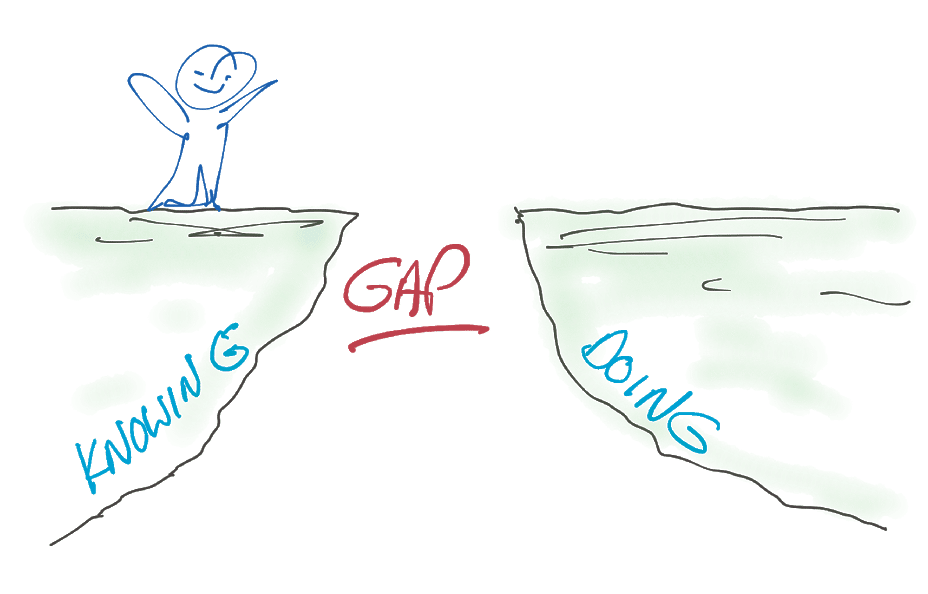
The reality is that strategy, the execution of strategy and the decisions associated with both functions have become much closer operationally than they were under a more traditional model of management. As strategy has become integral to a leadership / management role, two other things have happened:
1. The context in which strategy is developed has taken on a different shape and is far more complex than in previous times.
2. The responsibility for the execution of strategy has shifted.
Strategy is no longer simply about gathering data on products, customers and competitors. The wider context of the operating environment is now critical to strategic thinking. As well as thinking about industries, markets, competitors and customers, more global and less tangible considerations have become critical to organisational success and profitability. Considerations of the physical environment, political implications and impacts on communities and society more broadly are now just some of the essential elements of the context in which strategy is formulated today.

Furthermore, as middle management has disappeared and employees have begun to look for meaning in their work, the role of alignment between strategy formulation and the execution of strategy has become a shared responsibility of the senior management team (including the executive) and the rest of the employees in the organisation. As hierarchy has devolved, communication between organisational members – at all levels – has taken on far more complexity and far greater importance. This has led to what I called the ‘leadership gap’ (see figure below).
The (New) Top 10 Leadership Skills Employers Want and Need
Based on the ‘Leadership Gap’ and conversations with dozens of organisations across multiple industries, here is my assessment of the top 10 leadership skills needed (from the ‘outside-‘in’):
1. Eyes ‘Up & Out’
Good leaders have the ability to look outside their own organisation to understand trends in their industry and more broadly, society. They are then able to create a vision (a picture of the future) and mission (purpose) that best serves customers and supports building a strong organisation. Both vision and mission are important. As one of my clients put it (a Catholic-based not-for-profit)…
If there’s no money then there’s no mission!
2. Change Leadership
Leading change is complex because it encompasses virtually everything in our top 10. If leaders aren’t leading change in some shape or form, then they’re probably doing an excellent job managing the status quo. While managing ‘what-is’ is important in terms of producing high quality, reproducible results (think customer service), it is not the main game. True leadership involves mobilising people who are closest to the problem or opportunity and then supporting them to make the necessary changes.
3. ‘Network’ Savvy – Seeing the Whole

Many tasked with leadership are too focussed on what’s in front of them rather than being able to think in a ‘joined up’ way. Leaders need to be able to ‘see’ the whole system and understand how it operates in unison. Being savvy means being able to see how the human and mechanical systems (i.e. policies, processes, systems, and structure) work together to create a state of homeostasis – or no change. Being ‘network’ wise will become even more important. As someone once said….
Organisations are perfectly aligned to get the results they get.
4. Politically Savvy
Note that I said ‘politically savvy’, not ‘political’. There is a difference. Building on Leadership Skill 1 (Eyes Up and Out), being politically savvy means understanding the direction and depth of relationships, understanding people’s loyalties (e.g. people, history, ways of doing things, etc.) and finally, understanding the losses we’re asking people and teams to sustain as a result of our change or initiative (e.g. status, resources, money, stability, autonomy, being part of a tribe, etc.).
5. Leading Teams

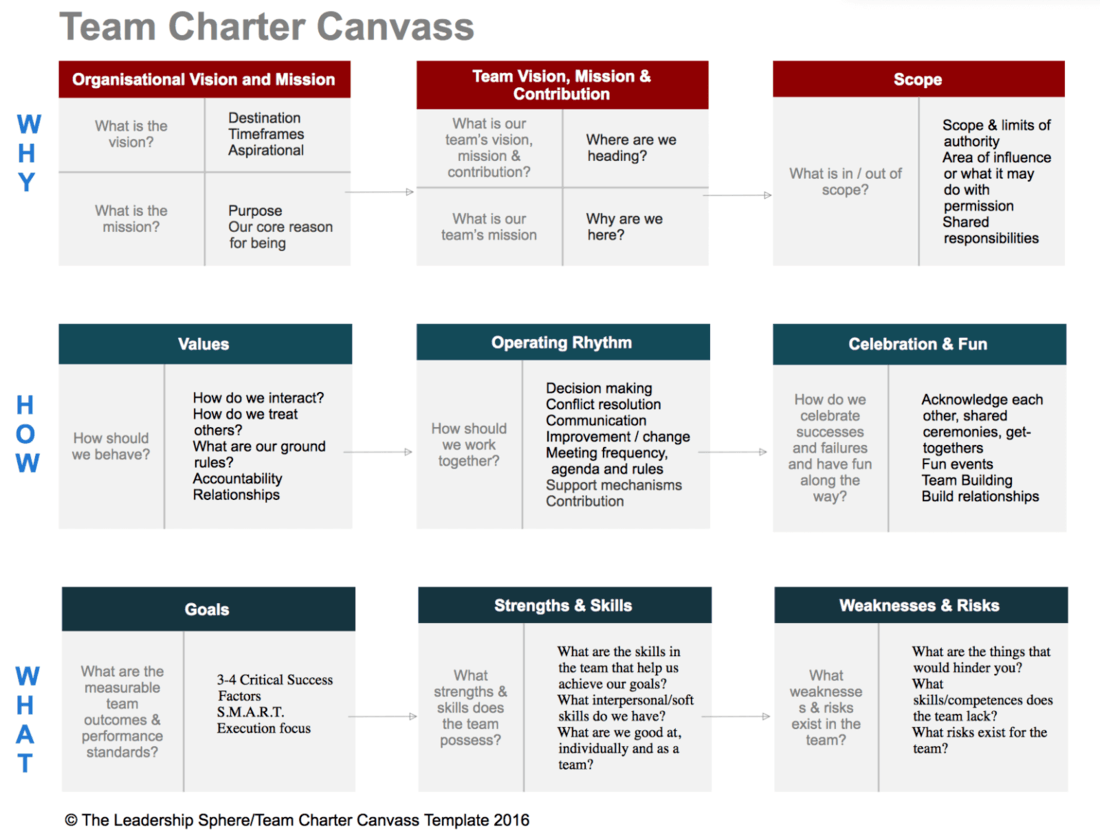
In the future, teams will become even more important. Leaders will need to be able to quickly form a team, separate and re-form faster than ever before to work on discreet parcels of work. Leaders will need the know-how to create a climate of performance and health quickly. In a previous post, I talked about our Team Charter Canvass (below) as a guiding document to do this effectively.
6. Developing People
Developing people could be the most important skill needed for the future. Today, the bias is for action and task completion, rather than growing and developing people. Learning and people’s everyday role functions are still too separated. Leaders will need to think differently by providing learning opportunities at the same time as getting the job done. What would it look like if a minimum of 50% of everything employees did provided a genuine development opportunity? What would be the benefits over time?
7. Building Relationships
It might sound obvious, but the ability to build relationships across functions, silos and diverse interests and agendas can be tricky business. The best build a platform of credibility that comes from being able to achieve results while fostering positive relations. The qualities and skills needed to do this successfully include genuine care for others, empathy and warmth.
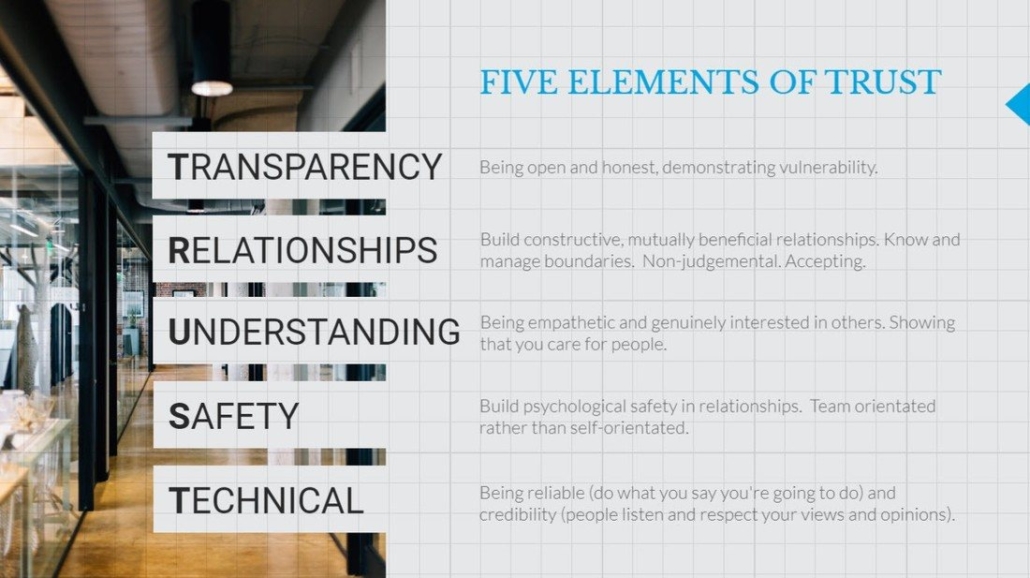
8. Trust
Trust is as old as time, but remains fundamental in shaping how we work, live and love. Effective leaders are able to build trust and be trustworthy. Nothing facilitates the speed of business like trust. Good leaders strike a balance between company and personal objectives by being open and transparent, but in the right amounts. It must make sense for the prevailing culture, mood and operating rhythm (e.g. sharing too much information that unnecessarily burden’s people for example).
9. Resilience
Effective leaders have the capacity to bounce back from set-backs and challenges. While they’re not robots by any stretch of the imagination, they have developed personal strategies that move beyond mere survival. In a world where more people are prone to a sense of overwhelm, developing the skills of resilience, particularly a balanced approach to life is vital.
10. Self-Mastery

Self-mastery is a term that may not be commonly used in business, but it really separates average leaders from the best leaders. While we are tribal in nature as a species, this doesn’t mean we always get along with each other. Unfortunately, we all have egos – and it is our ego that gets in the way of effective leadership. Brene Brown’s research and commentary on vulnerability is insightful. Brown suggests that in a culture of scarcity (that is, feeling we’re not smart enough, thin enough, wealthy enough, etc.), we constantly feel the need to prove to ourselves and others that we are in fact smart, competent, have it all together, etc.
So there you have it – my assessment of the Top 10 Leadership Skills that will best serve organisations now and in to the future. While each of these leader skills requires continuous attention, investment and support, the results for organisations and the communities they serve justifies the effort.
Find out More
We are specialists in powering teams through leadership. If you’re interested in learning more about these programs and how we may be able to work with you to achieve outstanding results, then you can:
Call us on 1300 100 857
Email: support@theleadershipsphere.com.au
Visit: https://theleadershipsphere.com.au/
Let us help you find what you’re looking for!