Overcome Strategy Execution Challenges with Clarity and Confidence
When an organisation’s strategy fails, it would be a mistake to assume the plan was wrong. The better place to look is the line of accountability. Senior leadership teams spend months crafting ambitious strategic priorities, only to watch momentum stall once the document leaves the boardroom. The common thread? Murky decision authority.
When ownership is unclear, accountability fades away. People hesitate. Decisions stack up waiting for approval. Execution slows through confusion about who is actually in charge of what.
Many organisations struggle with strategy execution challenges that have little to do with the strategy itself. The real issue is usually structural: roles and responsibilities overlap, or they are never defined with enough precision to be useful.
It is surprisingly common for senior leadership teams to discover, often too late, that several people each assumed someone else owned a key decision. Everyone nods along in the planning meeting. Nobody steps up when execution begins.
Without clear ownership, strategy execution becomes a game of passing the buck. Priorities drift between departments. Deadlines slip because no one felt the responsibility was truly theirs.
The Cost of Unclear Accountability
The consequences of ambiguous ownership compound quickly.
Decisions get delayed as people wait for permission or clarity on who should decide. What should take a day drags into weeks, as emails circulate and meetings multiply, simply to establish who has the authority to move forward.
Accountability gaps also breed finger-pointing. When targets are missed, teams spend energy assigning blame rather than solving the underlying problem. This erodes trust and makes the next strategic initiative even harder to execute.
Perhaps most damaging, teams lose momentum because no single leader has the authority to push through obstacles. Strategic initiatives that should move with urgency instead limp along, losing relevance as market conditions shift beneath them.
Define decision authority explicitly. Every strategic priority needs a named owner, along with clarity on exactly which decisions that person controls. Vague statements like “the marketing team owns this” are not enough. Specify the individual, their scope, and where their authority ends.
Invest in executive leadership coaching and leadership assessment tools. Senior leaders often need support to understand their precise role in execution, particularly when priorities cut across multiple functions. Leadership assessment tools can help identify where individuals are strong decision-makers and where they may need further development to take on greater ownership.
Conduct an assessment of current accountability structures. Before adding new processes, map what already exists. An honest assessment exercise will reveal where decision rights are duplicated, where they are missing entirely, and where legacy structures no longer match the organisation’s current priorities.
Create a culture where ownership means both authority and responsibility. As distinct from accountability, which is imposed externally, ownership is something people choose to take when they feel genuinely empowered. Leaders must pair any accountability measures with real decision-making power, or they risk creating compliance without commitment.
Hold regular check-ins focused on progress and removing blockers. These conversations should never be reduced to status reporting. The most valuable check-ins ask what is standing in the way and who needs support to keep moving, reinforcing ownership rather than simply monitoring it.
Critical Question for Your Organisation
Here is a simple test. Who is accountable for your top strategic priority right now?
If you hesitated, even for a moment, your execution is probably suffering more than you realise. That hesitation is not a minor detail. It is a direct signal that decision authority within your senior leadership team needs sharper definition.
Making Ownership the Foundation of Execution
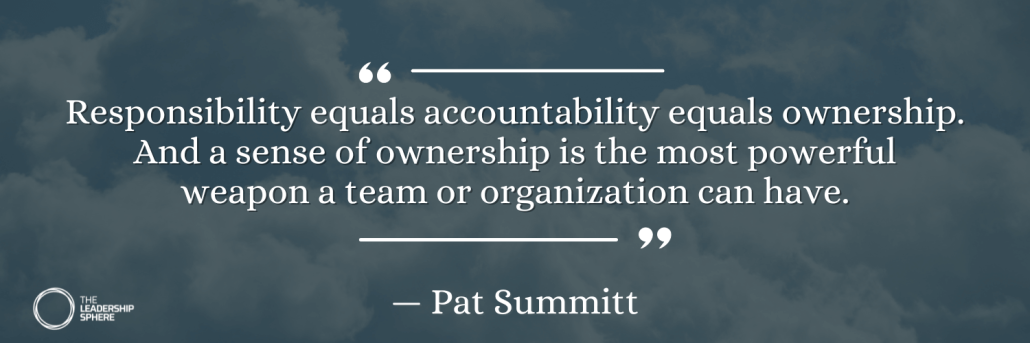
Clear ownership is the missing link between strategy and results. It is not enough to agree on priorities in a planning session; someone must hold genuine authority, and genuine responsibility, for seeing each one through.
Leaders who take the time to define decision authority, invest in executive leadership coaching, and conduct a proper assessment and profiling of their accountability structures put their organisations in a far stronger position. They close the strategy to execution challenges that undermine so many well-crafted plans.
Start with the question above. If the answer isn’t immediate and obvious across your senior leadership team, that is exactly where your next conversation about ownership needs to begin.
Clear Ownership: The Missing Link in Strategy ExecutionResearch…
https://theleadershipsphere.com.au/wp-content/uploads/2026/10/2610_005-Blog.png7561344Phillip Ralphhttps://theleadershipsphere.com.au/wp-content/uploads/2021/09/TLS_Blue-Grey-Horizontal-300x124-fix.pngPhillip Ralph2026-10-27 08:00:432026-10-28 16:44:32Clear Ownership: The Missing Link in Strategy Execution


 https://theleadershipsphere.com.au/wp-content/uploads/2026/10/2610_005-Article.png
1080
1920
Phillip Ralph
https://theleadershipsphere.com.au/wp-content/uploads/2021/09/TLS_Blue-Grey-Horizontal-300x124-fix.png
Phillip Ralph2026-10-30 08:00:172026-11-05 19:58:22How Leaders Unintentionally Undermine Execution