The Benefits of High Performance Coaching for Teams
Senior leadership coaching can provide many benefits for teams. It can help them to develop a shared vision and objectives, identify areas where they need to improve, and create an action plan to address those areas. Additionally, senior leadership coaching can help team members to build trust and communication, strengthen relationships, and learn new skills. Ultimately, executive coaching can help teams to achieve their full potential and be more successful.
Enhance Program Learnings
Executive coaching provides a safe space for executives and senior managers to explore their own limitations while learning how they can improve. Executive coaches challenge them by getting involved in ongoing leadership development programs, which will help the employee accept feedback so that both parties are more open-minded about accepting change or new ideas from each other as well outside sources such as colleagues within your team. The journey towards self discovery begins with understanding who you really are without any obstructions. This is what having a leadership development plan does; it allows you to focus on the areas where you need to grow without any distractions. It also gives you an opportunity to get new perspectives about your leadership style and how it affects your team’s performance.
Action-Oriented Feedback
Leadership coaching is not consultation; it is a partnership between the client and the coach. The role of executive coaching is to provide an objective, outside perspective and help the executive take action to improve his or her leadership skills. This type of coaching is different from other types of coaching, such as sports coaching or life coaching, because it is specifically focused on improving leadership skills. This coaching helps executives and professionals throughout organisational changes. It ensures the effective implementation of that change, allowing them to own their actions and roles in order for teams to be successful at implementing imposed new ones effectively.
Improved Organisational Performance
One of the ultimate goals of executive coaching is to help organisations improve their performance. This can be accomplished by developing the leadership skills training that involves the executives and senior managers within the organisation. When these leaders are able to effectively lead their teams, the organisation as a whole will be more successful. Additionally, executive coaching can help to create a high performance culture within an organisation.
“When employees feel that their leaders are invested in their development and growth, they are more likely to be engaged in their work.”
Improved Employee Engagement
Another of the advantages of leadership training and development coaching is that it can improve employee engagement. When employees feel that their leaders are invested in their development and growth, they are more likely to be engaged in their work. When leaders receive coaching, they are better able to model the behaviours that lead to high levels of employee engagement, such as effective communication, delegation, and conflict resolution.
Reduced Employee Turnover
Leaders who receive coaching learn how to create a work environment that is conducive to retention, such as providing high performance team development opportunities and offering regular feedback. When employees feel supported and valued by their leaders, they are less likely to leave the organisation.
Executive coaching provides many benefits for teams and organisations. Coaching can help individuals learn new skills, enhance program learnings, take action-oriented feedback, improve organisational performance, improve employee engagement, and reduce employee turnover. Executive coaching is an effective way to develop leadership skills and improve the performance of teams and organisations.
For more information about The Leadership Sphere and how we can help you unlock performance through leadership, by supporting your leaders at every level of the organisation with leadership development, executive coaching and high performance team programs please visit our website or call us on 1300 100 857.
https://theleadershipsphere.com.au/wp-content/uploads/2022/08/pexels-kampus-production-6248988.jpg333500Phillip Ralphhttps://theleadershipsphere.com.au/wp-content/uploads/2021/09/TLS_Blue-Grey-Horizontal-300x124-fix.pngPhillip Ralph2022-08-22 09:30:002022-09-21 16:38:39The Benefits of High Performance Coaching for Teams
Creating and Sustaining Psychological Safety in High Performing Teams
High performing teams need psychological safety. This means that team members believe it is safe to take interpersonal risks without fear of negative consequences such as criticism, punishments, being ignored or laughed at. When people feel accepted and respected, they bring their best selves to work. They are more likely to take risks, share new ideas, and give constructive feedback.
Creating psychological safety starts with the team leader. Leaders need to set the tone and make it clear that everyone is valued and respected. They should encourage open communication and discourage blamed-based thinking.
Sustaining psychological safety requires ongoing effort from everyone on the team. It takes time and patience to build trust and create an environment where people feel comfortable taking risks. But it is worth the effort, because high performing teams are able to achieve amazing things.
The Difference Between Psychological Safety and Trust
There is a key difference between psychological safety and trust. Psychological safety means that team members feel safe to take risks without fear of negative consequences. Trust means that team members are willing to cooperate and work together towards a common goal.
Trust is essential for any team to function effectively. Team members need to be able to rely on each other, and they need to trust that everyone is working towards the same goal. It is about how individuals treat and interact with one another.
Psychological safety is a shared belief and team norm that all team members adhere to. It allows team members to take risks and share new ideas, which can lead to innovation and creativity. Everyone in the group feels secure enough to participate.
Creating Psychological Safety In High Performance Teams
Creating psychological safety in high performance teams can be a challenge. However, there are a few things that team leaders can do to set the tone and encourage open communication.
1. Leaders need to set the example and be role models for healthy behavior. They should create a safe environment where taking calculated risks and voicing new ideas is encouraged.
2. Leaders should avoid blame-based thinking and engage in difficult conversations. When team members are able to communicate openly, they are able to resolve conflicts quickly and efficiently.
It is essential for team members to feel safe to take risks and share new ideas. Understanding the importance of cultivating a psychologically safe environment is an important factor in ongoing leadership development. When team members feel valued and respected, they are more likely to bring their best selves to work and contribute to the success of the team.
“Understanding the importance of cultivating a psychologically safe environment is an important factor in ongoing leadership development.”
Sustaining Psychological Safety In High Performance Teams
Encourage Risk-Taking
Allowing teams to make calculated risks is essential for their success. Risks can lead to innovation and creativity, which are essential for high performance teams. When team members feel safe to take risks, they are more likely to share new ideas and contribute to the team’s success. However, risks need to be calculated in order to avoid unnecessary mistakes.
Team leaders should encourage their team members to take risks, but also remind them that mistakes are part of the learning process. By taking risks and learning from their mistakes, team members can continue to improve their performance.
Tolerating Mistakes
When someone makes a mistake, it can be easy to get angry or criticize them. However, this can actually discourage people from taking risks and sharing new ideas. It can also damage relationships and hinder team progress.
A better approach is to focus on the mistake itself, not the person who made it. Ask what can be learned from the mistake and how you can prevent it from happening again. This is an integral part of high performance team programs. When mistakes are treated as learning opportunities, you create stronger teams and help them in developing leadership capabilities that will make them successful both now and in the future.
For high performing team development to be successful, participants need to feel safe in order to cooperate and work together effectively. Creating psychological safety is essential for building an effective high performance culture. Leaders should set the tone and example for healthy behavior, avoid blame-based thinking, and encourage open communication. When team members are able to communicate openly, they can resolve conflicts quickly and efficiently. Sustaining a psychologically safe environment is important for high performance teams so that they can continue to take risks, learn from their mistakes, and improve their overall performance.
The Leadership Sphere helps small and medium businesses and larger organisations in Australia, in creating value through leadership. The Leadership Sphere provides a humanistic approach to the way it delivers leadership, performance and coaching services. We work with leaders and senior teams who need to gain increased clarity, build capability and ensure contribution at every level in the organisation, and enable a safe, inclusive and high trust organisation.
https://theleadershipsphere.com.au/wp-content/uploads/2022/08/pexels-yan-krukov-8837760.jpg333500Phillip Ralphhttps://theleadershipsphere.com.au/wp-content/uploads/2021/09/TLS_Blue-Grey-Horizontal-300x124-fix.pngPhillip Ralph2022-08-19 09:30:002022-09-21 16:17:59Creating and Sustaining Psychological Safety in High Performing Teams
High performance teams are characterised by a number of distinct features. These teams are typically highly cohesive, with members working closely together towards common goals. They also tend to have high levels of communication and collaboration, as well as a strong sense of collective identity. In addition, high performance teams typically exhibit a high degree of adaptability, able to rapidly change course in response to new information or challenges. These teams consistently meet or exceed expectations.
While there is no single formula for building a high performance team, there are a number of characteristics that these teams typically share. By understanding and cultivating these features, you can create an environment that is more conducive to high levels of team performance.
Prioritise Communication
One of the key characteristics of high performance teams is communication. This means that team members are able to effectively share information and collaborate towards common goals. In order to facilitate this, it is important to prioritise communication within the team.
Some ways to do this include:
Making sure that everyone has an opportunity to share their ideas, and that no one is shy about speaking up
Encouraging open discussion and debate, so that everyone can understand different points of view
Creating a culture of trust, where team members feel comfortable sharing information and asking for help
Establishing rules or norms for communication, such as using clear and concise language, avoiding distractions, or taking turns speaking
The best high performance team programs are effective because of the emphasis placed on communication to make them successful. By prioritising communication, you can create a team environment that is conducive to high performance.
Understand Emotional Intelligence
One of the key factors that separates high performance teams from the rest is emotional intelligence. Emotional intelligence refers to a person’s ability to recognise and understand their own emotions, as well as the emotions of others. It is this ability to manage emotions that allows high performance teams to thrive.
Some ways in which emotional intelligence can benefit a team include:
Improved communication: When team members are able to recognise and understand their own emotions, as well as the emotions of others, they are better able to communicate effectively. This can lead to improved understanding and cooperation within the team.
Reduced conflict: Emotional intelligence can help team members to manage conflict effectively. When everyone understands and recognises their own emotions, as well as the emotions of others, it reduces the chance for conflict to arise.
Better decision making: High emotional intelligence can also lead to better decision making. When team members are able to control their emotions, they are less likely to be swayed by them when making decisions. This can lead to more rational and effective decisions.
Managing emotions is one of the key factors that contribute to high performance team development.
” It is important to be realistic in setting your goals, and to make sure that everyone on the team is on board with the plan.”
Have a Development Plan
In order to create a high performance team, it is important to understand where your team is currently and where you want them to be. This means setting clear goals and objectives for the team, and developing a plan to help them reach those goals.
The first step is to assess the current state of the team. This includes looking at factors such as communication, cooperation, and productivity. Once you have a good understanding of where the team is currently, you can begin developing a plan to help them reach their goals.
Your plan should include both short-term and long-term goals, as well as specific steps that the team can take to achieve those goals. This can include providing additional resources, support, and leadership training. It is important to be realistic in setting your goals, and to make sure that everyone on the team is on board with the plan.
By having a clear development plan in place, you can help your team reach their full potential and perform at their best.
Value Regular Feedback
Feedback is a crucial part of developing leadership skills training. It is through feedback that team members are able to understand how they are performing and identify areas for improvement.
When providing feedback, it is important to be clear, concise, and specific. It is also important to be objective and avoid personal biases. Feedback should be given regularly, and should cover both positive and negative aspects of the team’s performance.
You can assist team members by providing consistent feedback and revealing areas for improvement. Executive leadership courses can be a useful tool for tracking performance over time while providing participants with the skills needed to make those necessary improvements. This can help them to reach their full potential and perform at their best.
High Levels of Respect Between Leaders and Team Members
High levels of trust and respect are essential for any high performance team. When team members trust and respect one another, they are more likely to cooperate and communicate effectively.
Trust is built through mutual respect and positive interactions. It is not something that can be forced or faked. Team members must be willing to trust each other, and must be open and honest with one another.
Respect is earned through actions, not words. It is based on the understanding that every team member is valuable and contributes something unique to the team. Respect must be mutual in order to be effective.
When leaders and team members have high levels of trust and respect for each other, the team will be more successful. The relationships within the team will be stronger, and communication will flow more smoothly. Trust and respect are key ingredients for a high performance team.
High emotional intelligence, a development plan, regular feedback, and high levels of trust and respect are all essential ingredients for a high performance team. When team members have these qualities, they are more likely to cooperate and communicate effectively. These are just some of the advantages of leadership training. By developing a clear plan, you can help your team perform at their best by encouraging them to reach their full potential.
For more information about The Leadership Sphere and how we can help you unlock performance through leadership, by supporting your leaders at every level of the organisation with leadership development, executive coaching and high performance team programs please visit our website or call us on 1300 100 857.
https://theleadershipsphere.com.au/wp-content/uploads/2022/08/pexels-rodnae-productions-8069475.jpg333500Phillip Ralphhttps://theleadershipsphere.com.au/wp-content/uploads/2021/09/TLS_Blue-Grey-Horizontal-300x124-fix.pngPhillip Ralph2022-08-18 09:30:002022-09-21 16:09:235 Characteristics of High Performance Teams
The nature of our work has changed substantially from bygone days, particularly in the last two-plus years. Technological advances have further accelerated change. This means that work today is done quite differently than it was even a decade ago, let alone a century or more in the past. How we work has changed and continues to do so at an ever-increasing pace. This raises important questions: What does work mean in today’s world? How has the concept of work changed and what challenges does this present for an organization it’s and employees?
The Lone Wolf Never Wins
Although history has celebrated the lone-wolf entrepreneur, building high-performing teams far outweighs the solo game in modern organisational success. As digitalisation has changed the workplace and influenced many industries, building highly efficient teams is essential.
Too Many Teams Don’t Live Up to Their Potential
The experiences we have all had as a team member has no doubt varied widely. At some point in our lives, most of us have worked in a less than desirable team environment where toxic behaviours are the norm. In contrast, joining a high performance team can be rewarding and motivating for team members. Development of high-performance teams through training becomes an essential capability for organisations both small and large. Equally, developing the type of team leader who truly understand what it takes to build high-performing team members that consistently demonstrate outstanding results is paramount. One productive team will always achieve more than an average team. The added benefit of developing teams is that employee development occurs at the same time. Skill gaps are addressed concurrently through focused training and feedback.
Smart Versus Healthy
Many researchers and authors have written about and contrasted performance (or being smart) and organisational health. Partick Lencioni, for example, describes health as when an organisation’s management, operations, strategy, and culture fit together and make sense. Further, any organisation or team that wants to maximise its success must come to embody two basic qualities: it must be smart, and it must be healthy.
However, the focus for most teams is to be smart. Lencioni summarised it well in his book, The Advantage when he said:
“Smart teams are good at those classic fundamentals of business, but being smart is only half the equation, yet somehow occupies almost all the time, energy, and attention of most leaders. The other half of the equation, the one that is largely neglected, is about being healthy.”
– Patrick Lencioni, The Advantage
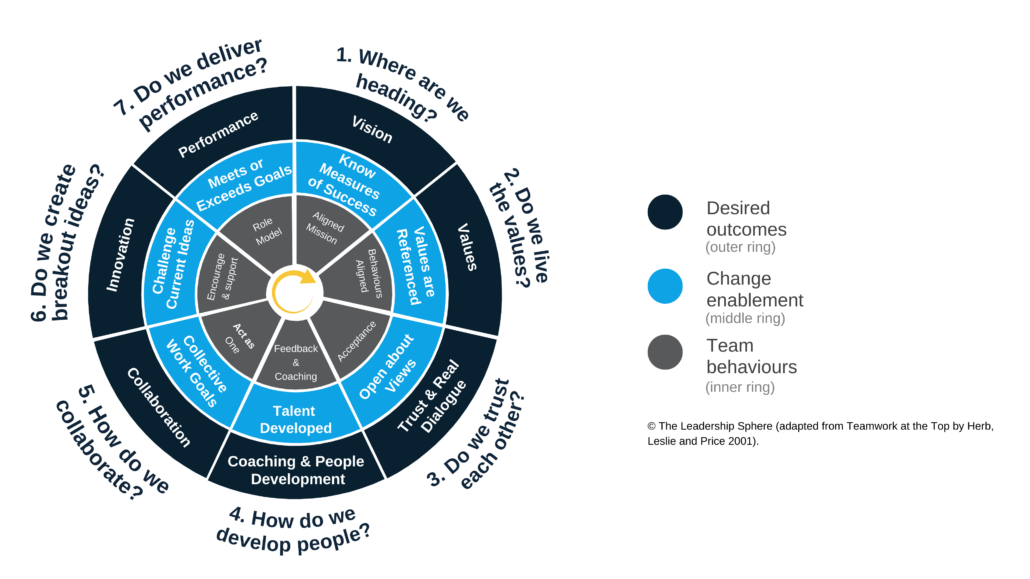
Successful organisations of tomorrow will be those that can create and sustain high-performing teams. So, what are the key elements of a high-performing team? We break them into two areas: (1) the Foundations and (2) the Seven Elements to build high-performance teams.
The Foundations
In our work with teams, we begin with a rigorous assessment of the foundations and the required key characteristics then turn to the seven critical areas that have been demonstrated to drive teamwork and team performance. While there is some overlap, we find that having an in-depth understanding of the foundational conditions and the seven drivers of high-performance creates a deep understanding of the team and therefore the development focus.
The six conditions of team effectiveness is based on the data science of Harvard scholar-practitioners Drs. Richard Hackman and Ruth Wageman who studied over 1,000 teams and includes:
Being a Real Team (not in name only);
Having the Right People on the team (complementary to each other);
Compelling Purpose (knowing why they exist);
Having a Sound Structure (e.g. the right team size);
Creating a Supportive Context and
Having effective Team Coaching readily available and being goal-orientated.
Seven Elements of High-Performing Teams (model below)
Healthy teams:
Know where they’re heading and how to get there;
Lives the values (behaviours are aligned);
Have high levels of trust and can engage in real dialogue (effective communication);
Coach and develop each other (and others around them);
Engage in constructive collaboration;
Have strong capability to innovate in service of their goals; and
Outperform expectations by delivering critical business imperatives.
This article will focus on the seven critical elements that drive high performance and health in teams.
1. Shared Sense of Purpose and Direction
High-performing teams have a clear direction, aligned mission and know their measures of success.
Myth: The team’s purpose is the same as the organisation’s purpose.
A team’s mission (or purpose) should never be the same as the organisation’s, yet many teams frame their reason-for-being in this way. A team’s purpose must be an enabling force to achieve the strategy rather than the strategy itself. This is a key difference. The team’s purpose must support the organisation and its employees, not the other way around. A useful way to formulate a team’s mission is to ask ‘What would be missing if we (the team) weren’t here?’
A high performing team requires a clear sense of direction and common goals. If it is the top team, then this may include the overall vision for the company. If, on the other hand, the team is responsible for a business unit, division or site, then the vision and direction would pertain to it at that level. This might sound obvious, but it’s often overlooked. Purposeful teams also celebrate success.
In our consulting, we always ask the following question of teams, ‘Which is your first team?’. This question is always met with puzzled looks and a myriad of responses. The correct answer is ‘this one‘, not the team they manage (or their functional team). If a team is to truly lead the organisation (or division or business unit, etc.), then it needs to be the team they are a part of, not the team they lead. Leaders must therefore be able to understand and separate the different approaches required in leading their functional areas versus the role and function of the leadership team. A common business goal, and being goal-orientated, must be agreed upon with such clarity that there is zero chance of misunderstanding.
2. Live the Values
High-performing teams have a clear set of values and behaviours which are agreed to, referenced and lived.
Myth: The organisation’s values can serve as a team’s values.
Virtually every team we work with – at least initially – believes that because there are organisational values they need team values. Team values and norms of behaviour become the ‘normal way of behaving’ by providing clear behavioural anchors regarding what is okay and what is not. Values are the beliefs that guide our behaviour, while norms are the expectations of each other’s behaviour.
Team norms should be focused and specific to the present day and what will be important in the next 12 months. Organisational values on the hand, aim to guide the entire organisation in a more general sense. Values and norms can change over time as the team evolves and as the members of the team change and usually reflects the results of the DiagnosticConnect feedback methodology.
Formulating an agreed set of values and behaviours makes it much more likely that the team is aligned and pushing together rather than against each other. This creates a sense of trust and mutual respect within the team, and enhances teamwork which is essential for effective collaboration. Everyone doesn’t need to share the same values but must be constructive and aligned in serving the team’s purpose.
3. Trust and Real Dialogue
High-performance teams trust each other, accept different views and engage in constructive, robust dialogue.
Myth: We don’t experience major ‘blow-ups’ or conflict because we have high trust.
Teams often attribute a ‘lack of conflict’ to high levels of trust, whereas it’s usually the exact opposite. Issues and challenges, including between team members, are usually suppressed and simply not addressed or at least not addressed fully. A lack of conflict is usually a symptom of a lack of trust and therefore candour. High-performing teams have the confidence and capability to communicate effectively by engaging in robust discussions without making it personal.
Trust is essential to feel connected, enabling team members to share ideas and information openly and provide feedback early and often. Without trust, team members will be reluctant to demonstrate vulnerability and engage openly, stifling communication, creativity and innovation. To use Brené Brown’s definition (TLS is certified by Brené Brown to deliver the Dare to Lead™ program), vulnerability is the emotion we experience during times of uncertainty, risk or emotional exposure.
It’s not about inappropriate disclosure. Being able to communicate openly means that people feel free to openly express their ideas and opinions without fear of judgement or reprisal. This open exchange of ideas is essential for generating creative solutions to problems.
4. Coach and develop people
The fourth element in creating and sustaining team performance is for leadership teams to coach and develop each other and those around them.
Myth: Developing ‘talent’ means developing your best people.
The ‘talent myth’ is alive and well in organisational life. There is very little evidence to suggest that developing employees who appear to be ‘talented’ or high performers will translate to a better return on investment than a more broad-based approach where everyone benefits from an uplift in capability, particularly in teams. In our High-Performance Team Framework, talent development means the creation of a context that allows everyone to shine in your team or organisation by leveraging strengths and building capability. It makes little sense to invest in the top 5% of employees for example while the other 95% also need to perform and make up a clear majority. There is power in a shared approach, language and baseline capability development.
Leadership teams must therefore be enablers of talent horizontally and vertically. Leveraging the work of Ken Wilbur, enabling strategies occur in four dimensions:
Mindsets;
Behaviours;
Culture; and
Systems, Structure and Processes.
If the Integral Model is the ‘what’, coaching is the ‘how’. Coaching is much more than asking open questions or the GROW Model. It is a leadership philosophy that goes beyond techniques. High-performing teams coaching each other and value peer-to-peer accountability above top-down accountability from managers. Managers also need to play an important role and be available when needed to support their charges.
Coaching allows the development of skills, knowledge and abilities in a safe and supportive environment – while addressing key priorities. The team culture, therefore, becomes one of support and collegiality where communication issues are addressed, emotional intelligence is valued and psychological safety is deepened. Coaching fosters being goal-orientated with clear objectives and utilising complementary skills already present in the team. Continuous learning becomes the norm.
5. Engage in Constructive Collaboration
The fifth element is that healthy teams act as one, enabled by collective work goals to create meaningful, constructive collaboration.
Myth: Teams must collaborate to achieve the objectives of individual silos.
While it is true that high-performance teams should be helping each other achieve individual objectives, it’s not enough. Real teams do real work together centered on a common goal. This means that individual goals must be subservient to common business goals. Common team goals foster collaboration and set the team up for success, ultimately creating superior results.
True collaboration links back to the ‘first team’ principle. If team members truly see the team they are a part of, rather than the one they lead, as their first team, it is highly likely they will act for the common good across the team rather than downwards. Leaders must focus primarily on their peers not downward to their own teams.
This reduces turf protection behaviour and frees teams up to be much more agile and responsive to each other’s needs. This kind of collaboration can be difficult, as it requires individuals to set aside their egos and work towards a greater goal. However, the rewards are well worth the effort. Collaboration allows team members to draw on a wider range of skills and knowledge, leading to more innovative solutions. In addition, those who engage in constructive collaboration develop deeper relationships with each other, resulting in a more cohesive team. When done right, collaboration can be an immensely powerful tool for achieving success.
6. Foster Innovation
Team members challenge current approaches while encouraging and supporting each other to foster innovation.
Myth: Innovation only comes from creative genius or big picture thinkers.
Innovation does not always have to be a revolutionary product or service; it can also refer to incremental changes that improve existing products or processes. In reality, innovation often happens when people take a fresh look at existing products, services, or processes and find ways to improve them. Finally, some believe innovation always requires big risks and massive investments. While this may be true in some cases, there are also many examples of innovations developed with little investment and risk. When done right, innovation can be an immensely powerful tool for success.
The key here is that communication is open and new ideas are not quashed before they’ve had a chance to breathe. Teams must avoid the one question that is fatal to innovation, ‘Yes but how would you do that?’ This immediately shifts the mindset from creation to logistics – a real brainstorming killer. Each person needs to encourage real learning by reflecting on their own and the team’s performance and looking for ways to improve.
7. Deliver Performance
The team meets or exceeds its goals and is a role model for getting things done.
Myth: We need to focus on performance to improve performance.
This myth is perpetuated across organisations all over the world. Teams believe they need to be smarter rather than healthier and focus on performance more than the soft stuff. There is simply no evidence to support this approach. Yes, you read (or heard) correctly. There is no evidence to support the notion that the vehicle to improving performance is through traditional methods of management – finance, marketing, strategy or technology. There needs to be a very solid ‘and’. I wrote about this over 10 years ago when reviewing the data and research from some of the most robust research available.
Since then, other authors have also put a line in the sand and made similar assertions. For example, Lencioni in his book The Advantage, makes a solid case for why teams need to focus on health more than performance. Again, not instead of….as well as.
In Tom Peters’ final book (according to the author of 18 books), the management guru says that all throughout his career he has been asked numerous times, ‘Tom, why have you focussed so heavily on the people side of business?’ to which he answers, ‘What else is there?’. I love his response.
While you can focus on the seventh element of performance all you like, it’s the other six elements in our High-Performance Team framework that will deliver performance. You can read more about how and why performance and health matter equally here.
The seventh and final element in our framework, then, is that healthy teams consistently outperform expectations.
Gaining Clarity
When all of these elements are present, the result is a high-performing team that is able to achieve amazing results over time. If you want your team to be successful, creating a healthy working environment is essential.
By focussing on these seven areas, teams can get clarity on:
Strengths and capabilities that can be harnessed more fully by the team.
Underlying issues and blockers, both personal and systemic.
‘Undiscussable’ issues that negatively impact the team.
Patterns and systems issues that are difficult to identify under normal circumstances.
Individual and/or leadership behaviours that enable and block team success.
Opportunities for individuals and the team (s) to improve performance.
The desired future and the role you choose to play.
Conclusion
Building high performing teams that consistently deliver results and where its members feel valued and engaged, requires team leaders to address all aspects of performance and health holistically. By only focusing on performance, teams will not achieve nor sustain the very thing they are seeking.
Things You Can Do From Here:
Get immediate results on your team by completing our HPT Survey.
You can also download our white paper: Another Poor Report Card on Organisational Culture: What Can We Learn?
The Leadership Sphere helps small and medium businesses and larger organisations in Australia, in creating value through leadership. The Leadership Sphere provides a humanistic approach to the way it delivers leadership, performance and coaching services. We work with leaders and senior teams who need to gain increased clarity, build capability and ensure contribution at every level in the organisation, and enable a safe, inclusive and high trust organisation.
https://theleadershipsphere.com.au/wp-content/uploads/2022/08/pexels-sora-shimazaki-5673507-scaled.jpg17072560Phillip Ralphhttps://theleadershipsphere.com.au/wp-content/uploads/2021/09/TLS_Blue-Grey-Horizontal-300x124-fix.pngPhillip Ralph2022-08-03 15:09:002022-08-16 21:05:00Seven Essential Elements of High-Performing Teams
Why Should Your Personal Values Align With Your Organisation’s?
It is important for your personal values to align with those of your organisation in order to create a harmonious working environment. By sharing similar values, you and your organisation can work together towards common goals and maintain a mutual understanding and respect for one another. Additionally, when your personal values align with your organisation’s, you are more likely to be satisfied with your job and motivated to do your best work.
Effective Communication
It’s no secret that effective communication is essential to success in any organisation. After all, how can high performance team members work together effectively if they can’t communicate with each other? Likewise, how can an organisation function smoothly if its members can’t communicate effectively with each other?
However, what many people don’t realise is that effective communication doesn’t just happen by chance. In order for communication to be truly effective, it needs to be aligned with the organisation’s values.
When communication is aligned with an organisation’s values, it creates a common understanding and language that everyone can use to work together more effectively. For example, if one of an organisation’s core values is “honesty,” then all members of the organisation should be open, truthful, and kind to each other when communicating. This creates an environment of trust and respect, which is essential for effective teamwork.
Likewise, if an organisation’s core value is “innovation,” then a leader who communicates a vision of innovation is much more likely to inspire others to follow than a leader who simply talks about being different.When leaders communicate their vision in a way that is aligned with the organisation’s values, it creates a strong connection between the leader and their direct reports. This connection is essential for developing leadership capabilities.
“Values are the beliefs that an organisation holds to be true, and they should shape everything from the way the organisation is run to the way it interacts with customers and clients.”
Managing Conflict
Conflict is a natural part of any relationship, and it’s no different in the workplace. In fact, conflict can actually be a good thing, as it can lead to new ideas and solutions that wouldn’t have been thought of otherwise.
Not all conflict is created equal. For example, constructive conflict is the type of conflict that happens when people are disagreeing in a way that is respectful and productive. This type of conflict can lead to positive outcomes, such as new perspectives and creative solutions.
On the other hand, destructive conflict is the type of conflict that happens when people are disagreeing in a way that is disrespectful and unproductive. This type of conflict usually leads to negative outcomes, such as decreased morale and productivity.
When managing conflict in the workplace, it’s important to encourage constructive conflict and discourage destructive conflict. One way to do this is to create an environment where people feel safe to disagree with each other. This can be achieved through leadership development programs that give teams the tools to lean into tough conversations.
Another way to encourage constructive conflict is to provide leadership training on how to handle conflict in a productive way. This can help people learn how to disagree without being disrespectful, and it can also help them understand when it’s appropriate to escalate a disagreement to a higher authority.
In short, managing conflict in the workplace is essential for maintaining a positive and productive work environment. By encouraging constructive conflict and discouraging destructive conflict, managers can help create an environment where people feel safe to disagree with each other, and where new ideas and solutions can be found.
Values are the foundation of any organisation, and they should be the guiding force behind all decision-making. Because of this, determining which values are most important to you can be an essential part of your leadership development. The best leadership training courses will help you understand how to lead authentically by keeping your values at the forefront. After all, values are the beliefs that an organisation holds to be true, and they should shape everything from the way the organisation is run to the way it interacts with customers and clients.
For more information about The Leadership Sphere and how we can help you unlock performance through leadership, by supporting your leaders at every level of the organisation with leadership development, executive coaching and high performance team programs please visit our website or call us on 1300 100 857.
https://theleadershipsphere.com.au/wp-content/uploads/2022/07/pexels-anna-shvets-3727464-scaled.jpg17072560Phillip Ralphhttps://theleadershipsphere.com.au/wp-content/uploads/2021/09/TLS_Blue-Grey-Horizontal-300x124-fix.pngPhillip Ralph2022-08-01 09:00:002022-08-16 12:11:55Why Should Your Personal Values Align With Your Organisation’s?
A high performance culture is one where employees are encouraged to continually improve their performance and contribute to the organisation’s success. It can lead to increased employee engagement, motivation and productivity. In order to create a high performance culture, organisations need to invest in their employees and provide them with the tools and resources they need to be successful. There’s no single recipe for success, but there are certain drivers of high performance that organisations can focus on to create a culture of excellence.
A Clear Purpose and Direction
When everyone in an organisation is aligned around a shared purpose, it can be a powerful motivator. High performance teams often thrive under pressure, and are able to do so because they are given a clear purpose and direction from their leaders. Having a clear sense of direction gives employees a sense of ownership and responsibility for achieving organisational goals.
Defined Roles and Responsibilities
It’s essential to have the right mix of skills and expertise on your team. But it’s also important that everyone is in the right role, with clearly defined responsibilities. Assessing the capabilities of your team can be an essential factor in high performance team development. When everyone knows their part in the bigger picture, it can help to create a sense of unity and collective purpose.
“Creating an environment where employees feel valued and respected is needed to create a sense of loyalty and commitment.”
Opportunity for Continuous Improvement
Organisations that are constantly looking for ways to improve their performance are more likely to achieve high levels of success. Encouraging employees to identify areas for improvement and implementing changes can help to keep everyone focused on moving forward. By developing leadership capabilities in your team, you ensure that they have the tools needed to help them reach goals now and in the future.
Effective Communication
Clear and effective communication is essential for any organisation. When everyone is on the same page, it’s easier to make progress towards shared goals. One of the advantages of leadership training is that it provides a common language around new concepts that help teams to communicate more effectively. Having regular updates and open channels of communication can help to ensure that everyone is informed and engaged.
A Positive Culture
A positive workplace culture can make a big difference to an organisation’s performance. Creating an environment where employees feel valued and respected is needed to create a sense of loyalty and commitment. Providing senior leadership training can help to instil trust in your team members and demonstrate that you are invested in their development. Fostering a positive culture can also help to attract and retain top talent.
By focusing on these drivers of high performance, organisations can create a culture of excellence that will help them to achieve their goals. This includes providing leadership development opportunities, as well as setting clear expectations and goals. Furthermore, organisations need to create an environment where employees feel valued and appreciated. When organisations have a high performance culture, it can lead to a number of benefits including increased profitability, improved employee morale, and reduced turnover. Additionally, high performance cultures are more likely to attract and retain top talent.
For more information about The Leadership Sphere and how we can help you unlock performance through leadership, by supporting your leaders at every level of the organisation with leadership development, executive coaching and high performance team programs please visit our website or call us on 1300 100 857.
https://theleadershipsphere.com.au/wp-content/uploads/2022/07/pexels-karolina-grabowska-7875898-scaled.jpg17072560Phillip Ralphhttps://theleadershipsphere.com.au/wp-content/uploads/2021/09/TLS_Blue-Grey-Horizontal-300x124-fix.pngPhillip Ralph2022-07-25 09:00:002022-08-16 11:52:495 Drivers of High Performance
It’s not enough to simply be in a position of power or authority. To be a truly effective leader, you need to be someone that others are naturally drawn to and want to follow. So how can you become that kind of leader?
The first step is to develop a deep understanding of what leadership means. It’s not about bossing people around or having all the answers. Leadership is about setting a clear vision, inspiring and motivating others to achieve collective goals, and being able to work together as a team. There are many different leadership styles, but the best leaders are those who are able to adapt their style to the situation and the people they are leading. To do this, you need to be aware of your own strengths and weaknesses, and be comfortable with who you are as a leader.
Be Authentic
People can spot a fake from a mile away, so it’s important that you be genuine in your leadership role. This means being true to yourself and your values, and not pretending to be someone you’re not. If you’re not comfortable with public speaking, for example, don’t try to be a motivational speaker. Be honest about your weaknesses and work on improving them. At the same time, highlight your strengths and use them to inspire others.
Authentic leadership stems from self-awareness. If you’re not aware of your own motivations, values and strengths, it will be difficult to be a leader that others can trust. Senior leadership coaching allows leaders the opportunity to dedicate time to discover the values that consciously or subconsciously underlie their leadership style. Once you have a good understanding of who you are, you can start working on being the best leader possible.
Be Transparent
Leaders who are open and honest with their team members are typically more respected and trusted. This means holding themselves accountable and sharing when they have made mistakes. Not only does doing so result in strengthened team relationships, it also provides learning opportunities for leaders while helping their teams avoid making those same mistakes.
When you undertake coaching for senior leaders, you gain deeper insight into your personal story and how it informs the way you lead. This type of leadership development coaching can provide leaders with the ability to leverage those insights in ways that inspire and motivate their teams.
“Personal and professional growth is important to everyone, so it’s important that leaders encourage their team members to continue learning and developing.”
Encourage Growth
Personal and professional growth is important to everyone, so it’s important that leaders encourage their team members to continue learning and developing. This means offering help and guidance when needed, but also letting team members take the lead when they’re ready. High performance training programs can provide teams with the skills and tools necessary to fulfil their highest potential. Affording them such opportunities shows that you trust and value their capabilities, which in turn motivates team members to do their best work.
As a leader, it’s also important that you continue to grow and develop. This not only keeps you sharp and up-to-date, it also shows your team members that learning is a lifelong process. Undertaking leading teams training can help you build on your existing skills and knowledge, and learn new techniques that you can apply in your role.
Show Courage
Leaders who are afraid to take risks often find themselves stuck in the status quo. But in order to move forward, sometimes risks need to be taken. This doesn’t mean being reckless, but it does mean having the courage to try new things and stand up for what you believe in, even when it’s not popular.
Executive leadership must be courageous in order to be effective. Showing courage can inspire others to do the same, and it allows you to set the tone for your organisation. When faced with difficult decisions, don’t be afraid to make the tough call. Your employees will respect you for it, and it will ultimately help your business succeed.
A leader that others want to follow is someone who is authentic, transparent, and encourages growth. They are also someone who shows courage in the face of difficult decisions. If you can be these things, you will be a leader that others respect and admire.
The Leadership Sphere helps small and medium businesses and larger organisations in Australia, in creating value through leadership. The Leadership Sphere provides a humanistic approach to the way it delivers leadership, performance and coaching services. We work with leaders and senior teams who need to gain increased clarity, build capability and ensure contribution at every level in the organisation, and enable a safe, inclusive and high trust organisation.
https://theleadershipsphere.com.au/wp-content/uploads/2022/07/linkedin-sales-solutions-NpyF7rjqmq4-unsplash-scaled.jpg17072560Phillip Ralphhttps://theleadershipsphere.com.au/wp-content/uploads/2021/09/TLS_Blue-Grey-Horizontal-300x124-fix.pngPhillip Ralph2022-07-22 10:00:002022-08-16 11:50:14How to be a Leader that Others Want to Follow
High performance thinking is a process that allows you to think more effectively and efficiently. It involves breaking down your thinking into smaller, more manageable chunks so that you can better focus on each individual task. This type of thinking can help you to improve your productivity, performance and results. Leaders with a high performance mindset don’t place limits on their potential for growth and success. Through leadership training, leaders can learn to leverage this type of thinking and allow them to excel in high-pressure environments.
Having a Positive Perspective on Failure
One of the best things about high performance thinking is that it doesn’t see failure as a negative. In fact, leaders who have a high performance mindset see failure as an opportunity to learn and grow. They use each setback as a chance to reflect on what went wrong and how they can do better next time. This type of thinking helps them to stay positive and motivated, even in the face of adversity. High performance thinkers are always looking for ways to improve and reach their goals. Engaging in senior leadership development can help them to build this mindset and push themselves to be better than they were yesterday. This attitude is what separates leaders who achieve great things from those who don’t take action.
Taking Action
High performance thinkers don’t just sit around and wait for things to happen, they take action. They are proactive and always looking for ways to improve their situation. Leaders who take action are more likely to achieve their goals because they are constantly moving forward. A leadership workshop or program can help you and your team develop the skills they need to be successful and overcome challenges. When you take action, it sends a powerful message to yourself and others that you are serious about reaching your goals.
“Leaders who take action are more likely to achieve their goals because they are constantly moving forward.”
Having a Clear Purpose
Another important aspect of high performance thinking is knowing your ‘why’. This means having a clear purpose or goal that drives you to achieve excellence. Leaders who know their ‘why’ are passionate and committed to what they do. They have a strong sense of purpose that keeps them focused and motivated. They are not easily distracted by irrelevant information or outside influences. Executive leadership programs that align with your focus and keep it in focus allow you to be more efficient and effective in everything you do. When your purpose drives your actions, it becomes easier to stay on track and achieve your goals. It also makes it easier to overcome obstacles and challenges along the way.
Being Coachable
Being coachable is another important trait of high performance thinkers. This means being open to feedback and willing to learn from others. Leaders who are coachable are always looking for ways to improve. They know that they can’t do it all on their own and they are always willing to listen to others. Being receptive to other people’s ideas is an important skill to hone when it comes to leadership development. It demonstrates that you value your team’s opinions and contributions to collective achievements. Being coachable also shows that you are humble and confident enough to admit when you need help.
High performance thinking is a vital quality for any leader who wants to be successful. It allows you to see failure as an opportunity, understand your purpose, take action, and be coachable. All of these qualities are important for anyone who wants to achieve their goals. Leaders with a high performance mindset are always looking for ways to improve and reach their goals. The best leadership and management courses provide tools to leverage high performance thinking to overcome challenges. This attitude is what separates leaders who achieve great things from those who only dream about it.
For more information about The Leadership Sphere and how we can help you unlock performance through leadership, by supporting your leaders at every level of the organisation with leadership development, executive coaching and high performance team programs please visit our website or call us on 1300 100 857.
https://theleadershipsphere.com.au/wp-content/uploads/2022/07/pexels-ivan-samkov-4238478-scaled.jpg17072560Phillip Ralphhttps://theleadershipsphere.com.au/wp-content/uploads/2021/09/TLS_Blue-Grey-Horizontal-300x124-fix.pngPhillip Ralph2022-07-18 08:56:442022-07-18 08:56:47What is High Performance Thinking?
As a business leader, you are expected to have all the answers. But what happens when you don’t?
Leaders often have a hard time being vulnerable. They’re either too busy trying to keep up appearances or they fear that exposing themselves will cause their people anxiety and insecurity. As Dr Brené Brown reveals in her research, vulnerability can be used as a strength. The coaching relationship can be an ideal space for them to learn how to recognise their vulnerability and show it appropriately rather than pretending they have everything under control or know all the answers.
In today’s fast-paced and ever-changing business world, being able to openly share your vulnerabilities with your team can be a powerful tool for building trust and fostering a culture of innovation. If you’re not comfortable being vulnerable, executive leadership coaching can help you learn how to be more open and authentic with your team.
Why Authentic Leadership Matters for Team Performance
It’s no secret that successful businesses are built on strong, high performance teams. And while there are many factors that contribute to a team’s success, one of the most important is leadership.
The most effective leaders are those who are authentic. They lead with integrity and are committed to their own personal growth and development, as well as the growth and development of their team members. Authentic leaders create a culture of trust, respect, and openness that allows team members to feel safe to take risks, experiment, and innovate. They establish an environment where everyone can do their best work and where people are motivated to achieve collective success.
When team members feel safe to take risks and be creative, they are more likely to come up with new ideas that can help the team succeed. And when team members feel like they are part of something larger than themselves, they are more likely to be engaged and committed to the team’s success. Authentic leadership is the foundation of any high performing team. Leadership coaching creates leaders who are authentic and helps them to build an environment where team members can thrive and where businesses can reach their full potential.
The Importance of Authenticity Within Team Relationships
Authenticity is critical for strong team relationships. When team members are authentic with each other, they build trust and respect. This creates a foundation for more effective communication and collaboration.
Team coaching can help cultivate stronger relationships by teaching team members how to be more authentic with each other. Through these programs, team members cultivate stronger personal connections that translate into more trusting working dynamics.
Leading teams training also emphasizes the importance of authenticity. These programs help team leaders learn how to create an environment where team members feel comfortable being themselves. This allows team members to share their ideas and perspectives more freely, leading to better decision-making and improved team performance.
The benefits of authentic leadership are clear, but it can be difficult to put into practice. Senior leadership team training can help team members and leaders alike create more authentic relationships that result in improved communication, collaboration, and performance.
For more information about The Leadership Sphere and how we can help you unlock performance through leadership, by supporting your leaders at every level of the organisation with leadership development, executive coaching and high performance team programs please visit our website or call us on 1300 100 857.
https://theleadershipsphere.com.au/wp-content/uploads/2022/07/pexels-elevate-digital-1647919-scaled.jpg14402560Phillip Ralphhttps://theleadershipsphere.com.au/wp-content/uploads/2021/09/TLS_Blue-Grey-Horizontal-300x124-fix.pngPhillip Ralph2022-06-23 14:15:452022-08-16 11:37:51The Power of Executive Coaching
Why Leading a Team is More Difficult than it Looks
When it comes to leading a team, there is a lot more than meets the eye. Sure, it may look easy from the outside – but the reality is that it takes a lot of hard work, dedication and commitment to successfully lead a team.
One of the most important aspects of being an effective leader is finding balance. You need to be able to juggle the various demands of your team members, while still remaining focused on the overall goal. It can be difficult to find this balance, but it is essential if you want to be successful.
Be Both Decisive and Collaborative
When it comes to leading a team, one of the most difficult things to balance is being both decisive and collaborative. On one hand, you need to be able to make decisions quickly in order to keep things moving forward. On the other, you need to be able to take input from your team and work together towards a solution that everyone can agree on. It can be a tricky tightrope to walk, but it’s important to find a balance between the two in order to be an effective leader.
One of the best ways to find this balance is to start by being clear about your vision for the team. It’s essential for businesses to have good communication and training for high performance. After all, effective communication is key to any successful organisation. Once you have a strong sense of where you want things to go, it will be easier to make decisions that are in line with that vision. At the same time, it’s important to involve your team in the decision-making process as much as possible. This will help them feel invested in the outcome and more likely to buy into your vision.
Finding the right balance between being decisive and collaborative can be difficult, but it’s an essential skill that can be developed through senior leadership training. By being clear about your vision and involving your team in the decision-making process, you can strike a balance and set your team up for success.
Mitigate Risk while Encouraging Innovation
Innovation is essential for any team that wants to be successful. Without it, businesses can quickly become stagnant and fall behind the competition. However, innovation comes with its own share of risks. When you’re trying something new, there’s always the chance that it might not work out the way you hoped.
As a leader, it’s your job to strike a balance between mitigating risk and supporting talent development by encouraging innovation. You need to take steps to protect your team from potentially harmful risks. At the same time, you need to create an environment where creativity and innovation can flourish.
One of the best ways to strike this balance is to set clear guidelines for what is and isn’t acceptable. This will give your team members a framework to work within, while still allowing them the freedom to be creative. At the same time, it’s important to encourage open communication and provide feedback – both positive and negative – in order to help your team members learn and grow.
Finding the right balance between risk and innovation can be difficult, but it’s essential for any leader who wants to be successful. By setting clear guidelines and encouraging open communication, you can create an environment where high performance teams can thrive.
“Be open to new ideas and willing to try new things. At the same time, don’t be afraid to let go of things that aren’t working.”
Flexible Leadership
As a leader, one of the most important qualities you need to have is flexibility. Things change all the time, and you need to be able to adapt quickly to keep up. This can be difficult, but it’s essential if you want to be successful.
One of the best ways to stay flexible is to keep an open mind. Be open to new ideas and willing to try new things. At the same time, don’t be afraid to let go of things that aren’t working. If something isn’t working, don’t be afraid to change course.
It’s also important to be flexible in your communication style. Not everyone communicates in the same way, so you need to be able to adjust your style depending on who you’re talking to. This can be difficult, but it’s essential if you want to be an effective leader.
Being flexible is one of the most important qualities for any leader. By keeping an open mind and being willing to adjust your communication style, you can be successful no matter what changes come your way.
Overcoming unexpected challenges while maintaining, or even exceeding, performance goals is a frequent concern for many leaders. Leading teams training often helps equip leaders with the skills necessary to balance the competing priorities of their role. Combined with high performance team programs, leaders and their teams are able to achieve greater levels of success.
The Leadership Sphere helps small and medium businesses and larger organisations in Australia, in creating value through leadership. The Leadership Sphere provides a humanistic approach to the way it delivers leadership, performance and coaching services. We work with leaders and senior teams who need to gain increased clarity, build capability and ensure contribution at every level in the organisation, and enable a safe, inclusive and high trust organisation.
https://theleadershipsphere.com.au/wp-content/uploads/2022/06/pexels-kampus-production-8428053-scaled.jpg17092560Phillip Ralphhttps://theleadershipsphere.com.au/wp-content/uploads/2021/09/TLS_Blue-Grey-Horizontal-300x124-fix.pngPhillip Ralph2022-06-17 10:00:002022-06-21 20:46:01Why Leading a Team is More Difficult than it Looks
The best leaders know how to lead a successful team. They know how to inspire their team members and keep them motivated. They also know how to communicate effectively and make sure everyone is on the same page. If you want to become a successful leader, you need to learn how to do these things too. The importance of senior leadership development cannot be overestimated. It is essential for organisational success and for the continued growth and development of staff. Senior leaders play a vital role in setting the tone and culture of an organisation, and in leading by example. They also provide mentorship and guidance to younger staff, and help create a positive and productive work environment.
Clarity in Communication
One of the most important things you can do as a leader is to ensure that your team has clarity on what they need to do. This means being very clear in setting your expectations. Your team should know what their goals are and how they contribute to the overall success of the organisation. If there is any confusion, take the time to explain things again. It is better to reiterate important information than to have your team guessing what they need to do.
Find the Right Fit
In order to have a successful high performance team, you need to make sure that you have the right people in the right roles. This means that each person on your team should be doing something that they are good at and enjoy. If someone is not a good fit for their role, it will only lead to frustration and poor performance. Development and training programs can help you to identify and support the enhancement of the key strengths of team members. Take the time to assess each team member and make sure that they are in the right role for their skills and personality.
“By equipping team members with the skills they need to succeed, leaders help to foster a culture of excellence and achievement.”
Empower Your Team
One of the most important things you can do as a leader is to delegate tasks and empower your team. This means giving them the responsibility to complete tasks and make decisions. It is important to trust your team and give them the autonomy to do their jobs. If you are constantly micromanaging, it will only lead to frustration and a feeling of being powerless. Guiding teams and providing direction are critical skills that can be enhanced through leading teams training. When you delegate tasks, then step back and let your team do their job, they grow in confidence and performance.
Be Curious
As the leader, you need to be constantly asking questions. This shows that you are interested in what your team is doing and that you want to know more about their work. Being curious also shows that you are open to new ideas and willing to learn from your team. If you never ask questions, it will only lead to a lack of communication and a lack of understanding between you and your team. Curiosity is also useful in training for high performance. A successful team is always learning, investigating, and looking for new ways to improve. That spirit of curiosity is what sets great teams apart and drives them to continued success.
Providing Feedback
Understanding the importance of providing effective feedback is integral. It is important to give both positive and negative feedback in order to help team performance improve. If you only give positive feedback, your team will become complacent and they will not strive to improve. However, if you only give negative feedback, it will only lead to frustration and a feeling of being inadequate. Try to find a balance when giving feedback and make sure that it is constructive.
Great leaders know how to keep their team focused and motivated, even when the going gets tough. By equipping team members with the skills they need to succeed, leaders help to foster a culture of excellence and achievement. In addition, development and training programs can also help to build team cohesion and communication, both of which are essential for high performing teams.
For more information about The Leadership Sphere and how we can help you unlock performance through leadership, by supporting your leaders at every level of the organisation with leadership development, executive coaching and high performance team programs please visit our website or call us on 1300 100 857.
https://theleadershipsphere.com.au/wp-content/uploads/2022/06/pexels-ivan-samkov-8117438-scaled.jpg17082560Phillip Ralphhttps://theleadershipsphere.com.au/wp-content/uploads/2021/09/TLS_Blue-Grey-Horizontal-300x124-fix.pngPhillip Ralph2022-06-16 15:23:282022-08-16 11:31:015 Tips for Leading a Successful Team
While there is no one formula for developing leaders, there are some essential elements that are necessary for any leader to be successful. These include:
– A clear understanding of what leadership is and what it entails. Leaders must be able to inspire and motivate others, and they must also be able to make difficult decisions when necessary.
– The ability to develop and maintain relationships with those they lead. Leaders must be able to build trust and respect with their team members in order to be effective.
– A willingness to continuously learn and grow in their role. Leaders must be open to new ideas and willing to change their approach if it is not working.
Developing leaders is essential for any organisation that wants to be successful. By investing in leader development, organisations can create a pipeline of talent that will help them achieve their goals.
What is Leadership?
Leaders play a critical role in shaping organisational culture. They can help create a positive and productive environment by setting the tone and example for others to follow. It is the set of values, beliefs, and behaviours that shape how employees think, feel, and act. A strong organisational culture can inspire and motivate teams to achieve their best. It can also provide a sense of stability and direction during times of change.
Development and training are essential to creating effective leaders. They help leaders gain the knowledge and skills they need to be successful. Training helps leaders keep up with changes in the workplace and learn new ways to motivate and inspire their teams. Development opportunities give leaders the chance to grow and improve their abilities. These experiences can help leaders become more effective and successful in their roles.
“Leaders who are not adequately developed are more likely to make mistakes, lose the trust of their followers, and fail to achieve their goals.”
Maintaining Relationships in Teams
Creating leaders requires talent development at every level. It starts with identifying potential leaders and providing them with opportunities to grow and develop their skills. But it doesn’t stop there. As leaders move up through the ranks, they need to continue to develop their abilities so that they can effectively lead others.
Talent development is essential to senior leadership teams because it provides the tools and skills they need to lead effectively. Leaders who are not adequately developed are more likely to make mistakes, lose the trust of their followers, and fail to achieve their goals.
Leading teams training is one way to develop the skills and abilities needed to be an effective leader. This type of training can provide leaders with the knowledge they need to make sound decisions, build strong teams, and navigate difficult situations. Senior leadership training can also help leaders sharpen their own skills so that they can better lead others.
Leaders come in all shapes and sizes, but there are a few common qualities that make them successful. If you’re looking to become a leader, or if you want to be more effective in your current role, keep these things in mind. It takes hard work and dedication to be a good leader, but it’s definitely worth it.
Are there any other qualities you think are important for leaders?
The Leadership Sphere helps small and medium businesses and larger organisations in Australia, in creating value through leadership. The Leadership Sphere provides a humanistic approach to the way it delivers leadership, performance and coaching services. We work with leaders and senior teams who need to gain increased clarity, build capability and ensure contribution at every level in the organisation, and enable a safe, inclusive and high trust organisation.
https://theleadershipsphere.com.au/wp-content/uploads/2022/06/anthony-tyrrell-Az55JCPq1Is-unsplash.jpg7851080Phillip Ralphhttps://theleadershipsphere.com.au/wp-content/uploads/2021/09/TLS_Blue-Grey-Horizontal-300x124-fix.pngPhillip Ralph2022-06-08 10:00:002022-06-03 11:22:01What is essential to developing leaders?
As a leader, you are responsible for guiding and motivating your team to reach common goals. But what does it take to be a successful leader? While there is no one formula for success, there are certain qualities and skills that all great leaders share. Whether you’re a developing leader or an experienced one, honing these abilities can have a significant impact on your leadership and help to set you, and your team, up for success.
No Perfect Way to Lead
Leadership is not a one size fits all approach, the key is to learn what works for you and your team. There are senior leadership training programs available to help equip you with the skills you need to be an effective leader. Different leadership styles work better in different situations, so it’s important to find the style that works best for you. Senior leadership training can help you learn about different leadership styles and how to adapt your own style to fit the needs of your team.
Value of Continuous Learning
As a leader, it’s important to continuously learn and grow. This means being open to feedback, taking leadership development courses and reading leadership books. By continuously learning, you’ll be able to better assess your strengths and weaknesses and develop an approach that works best for you and your team. Additionally, leadership assessments and profiling can be extremely beneficial in helping you identify your leadership style and the areas you need to work on.
“When everyone feels valued, respected and supported, they are more likely to go above and beyond to achieve goals.”
Be Decisive
Being decisive is an important quality for senior leadership teams. The ability to make decisions quickly and efficiently is key to keeping a team on track and ensuring that goals are met. Of course, not every decision will be popular, but it is important to stand by your convictions and maintain a clear vision for the team. When senior leaders are able to be decisive, it sets the tone for the entire team and allows everyone to work together more effectively.
Emotional Intelligence is Key
When it comes to leading a team, emotional intelligence is key. In order to create a high performing team, it is essential to understand and manage the emotions of both yourself and your team members. Beginning at the individual level, leading teams training shows leaders how knowing themselves better, results in stronger strategic leadership and greater team performance. When everyone feels valued, respected and supported, they are more likely to go above and beyond to achieve goals.
Listen More than They Speak
It’s important for leaders to listen more than they speak. By doing so, they can learn about their team’s needs and how they can best be supported. Additionally, listening fosters trust and respect between leader and team members. Leaders who take the time to listen to their team members show that they value their input and are more likely to build a strong, cohesive team.
Show Appreciation
It’s important to show appreciation for your team’s hard work – this will help them feel valued and motivated. A simple ‘thank you’ can go a long way! You could also consider other ways of showing appreciation, such as public recognition or awards. Remember, every team is different, so take the time to learn what works best for yours. With a little bit of effort, you can create a positive and productive team environment that everyone enjoys being a part of.
Be an Example
Leaders should always lead by example. If you want your team to be passionate, then you must show passion yourself. Your team will take their cues from you, so it’s important that you set the right tone. Of course, this doesn’t mean that you have to be perfect. No one is perfect. But it does mean that you need to be aware of your own behavior and how it might be affecting your team. If you make a mistake, own up to it and learn from it. Your team will respect you all the more for it.
Excelling at team management can be a challenge, but it’s also incredibly rewarding. Remember, there is no perfect way to lead, so don’t be afraid to experiment and find what works best for you and your team. And always keep learning – the best leaders never stop growing.
For more information about The Leadership Sphere and how we can help you unlock performance through leadership, by supporting your leaders at every level of the organisation with leadership development, executive coaching and high performance team programs please visit our website or call us on 1300 100 857.
https://theleadershipsphere.com.au/wp-content/uploads/2022/06/pexels-vlada-karpovich-4050320.jpg7201080Phillip Ralphhttps://theleadershipsphere.com.au/wp-content/uploads/2021/09/TLS_Blue-Grey-Horizontal-300x124-fix.pngPhillip Ralph2022-06-06 10:00:002022-06-03 11:23:417 Things All Leaders Should Know
Why You Should Assess Your Leadership Skills (And How To Do It)
You may not realise it, but if you’re in a leadership position – or aspire to be one – then assessing your leadership skills is crucial. Think about it this way: as a leader, you’re responsible for guiding and motivating your team to achieve success. But how can you do that effectively if you’re not aware of your own strengths and weaknesses?
Fortunately, there are ways to assess your leadership skills and team management so that you can identify areas for improvement. Here’s why you should do it – and how to go about it.
Why Assess Your Leadership Skills?
Leadership is a critical skill for anyone in a management or supervisory position. But it’s not just something that managers need to be good at – everyone can benefit from honing their leadership skills. It is an important first step in leading teams training.
A leadership assessment allows you to get feedback from others on your performance. This is valuable because it can help you to identify both your strengths and weaknesses. It can help you to understand how you compare to other leaders. This benchmarking can be useful in terms of setting goals for yourself and your team. Regular assessment ensures that you’re always aware of your development needs and can take steps to improve your skills over time.
How To Choose A Leadership Assessment
There are many different types of leadership assessment and profiling tools available, so it’s important to choose the right one for your needs. Here are a few factors to consider:
• Purpose: What do you want to use the assessment for? If you’re trying to identify potential leaders, you’ll need a different assessment than if you’re trying to improve your own leadership skills. This is particularly important in determining the type of leadership development program that may follow the initial assessment.
• Population: Who will be taking the assessment? If you’re administering it to a senior leadership team, you’ll need to choose an assessment that’s appropriate for that group. For example, if you’re assessing teenage girls, you wouldn’t use an assessment that’s designed for middle-aged men.
• Time: How much time do you have to complete the assessment? Some assessments can be completed in just a few minutes, while others may take an hour or more. Choose an assessment that fits within the time frame you have available.
Leadership assessments are a necessary part of any leader’s toolkit. Once you’ve taken a leadership assessment, it’s important to spend some time reflecting on the results. What do the results tell you about your leadership style? Are there any areas where you need to improve? How can the results be used to inform leading teams training? Once you know what needs to change and how it can be improved upon then only will achieving your desired outcome become a reality for yourself as well as others who depend upon your leadership.
For more information about The Leadership Sphere and how we can help you unlock performance through leadership, by supporting your leaders at every level of the organisation with leadership development, executive coaching and high performance team programs please visit our website or call us on 1300 100 857.
https://theleadershipsphere.com.au/wp-content/uploads/2022/05/pexels-ivan-samkov-8117590-scaled.jpg17082560Phillip Ralphhttps://theleadershipsphere.com.au/wp-content/uploads/2021/09/TLS_Blue-Grey-Horizontal-300x124-fix.pngPhillip Ralph2022-06-01 22:00:002022-06-02 13:06:22Why You Should Assess Your Leadership Skills (And How To Do It)
Organisations are driven to success through the support of high performance teams. Likewise, those teams are able to achieve such strong results by leveraging the support of their leaders. Great leaders understand the importance of creating a culture of honesty and trust within their teams that allows them to perform at consistently high standards.
Honesty
When it comes to leading a successful team, training for high performance is essential. However, what’s even more important than training is honesty. Without honesty, training will only get you so far. In order to be a successful leader, you must be honest with yourself and your team. This means being transparent about your goals, your expectations, and your feedback. Honesty builds trust and respect, both of which are essential for any successful team. If you’re looking to lead a successful team, start by being honest with yourself and your team members.
Build Trust
Trust is essential for any successful team. Without trust, team members will be hesitant to take risks, try new things, or speak up when they have a great idea. Therefore, it’s important for leaders to build trust within their team. One way to do this is by being transparent and honest with your team members. Another way to build trust is by showing that you have faith in your team’s ability to succeed. Leading teams training can be an effective talent development tool that encourages leaders to provide opportunities for team members to showcase their abilities and take initiatives. When you show that you trust your team, they’ll be more likely to trust you and their fellow team members.
“If you want to lead a successful team, start by being honest with yourself and your team members. “
Set Clear Expectations
Setting clear expectations is another important element of successful team leadership. Your team members need to know what is expected of them, both in terms of their individual roles and in terms of the team’s overall goals. If you’re not clear about your expectations, your team will likely become frustrated and eventually give up. So it’s important to set the tone from the start by being clear about what you expect from your team. Engaging in high performance team programs can help to establish a clear understanding of expectations while providing teams with the tools and skills needed to meet them. Once you’ve set clear expectations, it’s much easier to hold your team members accountable and ensure that everyone is working towards the same goal.
One of the key benefits of senior leadership training is that it helps to develop honesty, trust, and clarity within an organisation. If you want to lead a successful team, start by being honest with yourself and your team members. Set clear expectations and give feedback regularly. And finally, build trust within your team by showing that you have faith in their ability to succeed. By following these simple steps, you can develop a strong and cohesive team that is capable of achieving great things.
The Leadership Sphere helps small and medium businesses and larger organisations in Australia, in creating value through leadership. The Leadership Sphere provides a humanistic approach to the way it delivers leadership, performance and coaching services. We work with leaders and senior teams who need to gain increased clarity, build capability and ensure contribution at every level in the organisation, and enable a safe, inclusive and high trust organisation.
https://theleadershipsphere.com.au/wp-content/uploads/2022/05/pexels-karolina-grabowska-7679907.jpg8731080Phillip Ralphhttps://theleadershipsphere.com.au/wp-content/uploads/2021/09/TLS_Blue-Grey-Horizontal-300x124-fix.pngPhillip Ralph2022-05-21 10:00:002022-05-24 11:00:28How to Lead a Successful Team
It’s tough to be a leader when your team isn’t performing. You may feel like you’ve tried everything to get them back on track, but nothing seems to be working. There are an infinite number of factors that may be affecting team performance. Understanding your team is often key to understanding the issue and how to overcome the challenges they face.
Filling Competency Gaps
Competency gaps can have a negative impact on organisational performance, as they can lead to a lack of skilled employees who are able to meet the demands of the organisation. Talent development can help to identify and fill competency gaps, by providing employees with the opportunity to enhance their skills and abilities. By offering development and training opportunities, businesses can ensure that they have the right mix of skills and abilities to meet their organisational needs.
Succession Planning
Succession planning is a key part of talent management, as it ensures that there is a pool of skilled and qualified employees who are able to take on leadership roles in the event of turnover or retirement. When leadership development programs are provided to individuals at all levels, not only does performance increase in the short term, it sets both them and the business up for future success.
“When senior leaders involve their teams to implement positive change, employees become more engaged with the work and experience higher job satisfaction.”
Employee Retention
Employee retention is a challenge for many organisations, as it can be difficult to keep talented employees from leaving. Talent management can help to improve employee retention by providing opportunities for growth and development. Leading teams training increases engagement within senior leadership teams as well as their own direct reports. When executives and other senior leaders involve their teams to implement positive change, employees become more engaged with the work, experience higher job satisfaction, and are less likely to seek external opportunities.
Talent management is about more than just hiring and firing employees. It is also about providing employees with the opportunity to grow and develop their skills, and supporting them in their career journey. By investing in talent management, organisations can create a pipeline of leaders and managers, and can also improve employee engagement and retention.
The Leadership Sphere helps small and medium businesses and larger organisations in Australia, in creating value through leadership. The Leadership Sphere provides a humanistic approach to the way it delivers leadership, performance and coaching services. We work with leaders and senior teams who need to gain increased clarity, build capability and ensure contribution at every level in the organisation, and enable a safe, inclusive and high trust organisation.
https://theleadershipsphere.com.au/wp-content/uploads/2022/05/pexels-le-cy-10846185.jpg7201081Phillip Ralphhttps://theleadershipsphere.com.au/wp-content/uploads/2021/09/TLS_Blue-Grey-Horizontal-300x124-fix.pngPhillip Ralph2022-05-18 10:00:002022-05-24 10:46:19What to do When Your Team Isn’t Performing
Organisational culture plays an important role in the success of any organisation. A positive organisational culture can help to attract and retain the best talent, and can also motivate employees to be productive and innovative. Talent management is a key part of creating and maintaining a positive organisational culture, as it ensures that the right people are in the right roles, and that they are given the opportunity to develop their skills and abilities.
Filling Competency Gaps
Competency gaps can have a negative impact on organisational performance, as they can lead to a lack of skilled employees who are able to meet the demands of the organisation. Talent development can help to identify and fill competency gaps, by providing employees with the opportunity to enhance their skills and abilities. By offering development and training opportunities, businesses can ensure that they have the right mix of skills and abilities to meet their organisational needs.
Succession Planning
PSuccession planning is a key part of talent management, as it ensures that there is a pool of skilled and qualified employees who are able to take on leadership roles in the event of turnover or retirement. When leadership development programs are provided to individuals at all levels, not only does performance increase in the short term, it sets both them and the business up for future success.
Employee Retention
Employee retention is a challenge for many organisations, as it can be difficult to keep talented employees from leaving. Talent management can help to improve employee retention by providing opportunities for growth and development. Leading teams training increases engagement within senior leadership teams as well as their own direct reports. When executives and other senior leaders involve their teams to implement positive change, employees become more engaged with the work, experience higher job satisfaction, and are less likely to seek external opportunities.
Talent management is about more than just hiring and firing employees. It is also about providing employees with the opportunity to grow and develop their skills, and supporting them in their career journey. By investing in talent management, organisations can create a pipeline of leaders and managers, and can also improve employee engagement and retention.
For more information about The Leadership Sphere and how we can help you unlock performance through leadership, by supporting your leaders at every level of the organisation with leadership development, executive coaching and high performance team programs please visit our website or call us on 1300 100 857.
https://theleadershipsphere.com.au/wp-content/uploads/2022/05/pexels-fauxels-3183179-scaled.jpg17792560Phillip Ralphhttps://theleadershipsphere.com.au/wp-content/uploads/2021/09/TLS_Blue-Grey-Horizontal-300x124-fix.pngPhillip Ralph2022-05-12 10:00:002022-05-24 10:03:51The Role of Talent Management for Success
How Effective Leaders Get the Most Out of Their Team
Effective leaders know how to get the most out of their team. By setting goals, providing support, and establishing an environment of trust, leaders can create a productive and successful team dynamic. In order to be an effective leader, it’s important to understand what motivates your team and how to best communicate with them.
Build Trust
The most effective leaders know that trust is the foundation of any successful team. Without trust, team members will be unwilling to take risks or put their full effort into achieving goals. To build trust, effective leaders need to be transparent and honest with their team. They should also create an environment where team members feel safe to openly share their ideas and concerns.
Ensuring psychological safety is one of the most important factors in effective team management. If team members fear negative repercussions for raising concerns, the issue won’t be resolved and you de-incentivise individuals to perform well. However, when you demonstrate that their concerns are as important to you as your own and work to resolve them together, you establish a culture of trust. When there is reciprocity of trust, teams are able to problem solve more effectively and performance increases.
Delegate Tasks and Encourage Autonomy
Effective leaders know that they can’t do everything themselves and that it’s important to delegate tasks to their team members. But they also know that simply delegating tasks isn’t enough – they need to give team members the autonomy to complete those tasks in their own way.
By giving team members autonomy, leaders show that they trust them to get the job done. This, in turn, motivates team members to do their best work and take ownership of their projects. This is of particular importance to developing leaders and those in the early stages of their leadership development journey.
“One of the most important things that effective leaders do is ensure that their goals are aligned with their organisation’s values.”
Goal and Value Alignment
One of the most important things that effective leaders do is ensure that their goals are aligned with their organisation’s values. By doing this, they create a strong sense of purpose within their team that motivates them to work towards the common goal.
Achieving this alignment can be difficult, but it’s worth the effort. Leading teams training can help you to integrate organisational values into the goals of your team. Discussing your values and how they connect to team goals regularly, ensures your team has a complete understanding of their importance. When your team knows that their work is contributing to something larger than themselves, they’ll be more engaged and committed to seeing the project through to completion.
Provide Effective Feedback
Feedback is essential for any team’s success. Effective senior leadership teams know that they need to give both positive and negative feedback to their team members in order to help them improve.
Positive feedback reinforces good behaviour and lets team members know when they’re doing a good job. Negative feedback, on the other hand, is necessary for helping team members correct mistakes and learn from their errors. Leadership training programs provide leaders with the skills needed to have crucial conversations with their teams and give more effective feedback.
Effective leaders understand that developing a strong team is essential to the success of their business. By building trust, delegating tasks, aligning team goals with organisational values, and giving feedback, they create an environment where team members can do their best work and reach their full potential.
The Leadership Sphere helps small and medium businesses and larger organisations in Australia, in creating value through leadership. The Leadership Sphere provides a humanistic approach to the way it delivers leadership, performance and coaching services. We work with leaders and senior teams who need to gain increased clarity, build capability and ensure contribution at every level in the organisation, and enable a safe, inclusive and high trust organisation.
https://theleadershipsphere.com.au/wp-content/uploads/2022/05/pexels-ivan-samkov-8117472-scaled.jpg17082560Phillip Ralphhttps://theleadershipsphere.com.au/wp-content/uploads/2021/09/TLS_Blue-Grey-Horizontal-300x124-fix.pngPhillip Ralph2022-05-10 10:00:002022-05-24 09:53:30How Effective Leaders Get the Most Out of Their Team
A leadership assessment is a process of evaluating an individual’s leadership qualities. This information can then be used to help develop and improve leadership skills. There are many different types of leadership assessments, but all share the same goal: to provide accurate and actionable information about someone’s leadership strengths and weaknesses. In today’s business world, it is more important than ever to have an effective team in place. A leadership assessment can help you create high performance teams that meet your company’s specific needs.
Leverage Strengths and Mitigate Weaknesses
Without leadership assessment, teams are often left directionless and without a clear understanding of how to improve. Assessment provides the team with valuable feedback that can be used to make positive changes and assist in team management. They can help reinforce investment and motivation in team members to achieve higher levels of success.
Leadership assessment is an essential tool for any team that wants to achieve its full potential. Leading teams training can be designed with assessment results in mind that addresses the specific needs of your team. By taking the time to assess team strengths and weaknesses, managers can ensure that their team is on the right track for success by providing a roadmap for development and growth.
“Leadership assessments help you build a stronger, more cohesive team that is better equipped to handle the challenges of today’s business world.”
Provide a Measurement of Success
Leadership assessment is an important tool for senior leadership teams. By conducting regular assessments, you can ensure that your team is always performing at its best and identify any training needs. This will help you build a stronger, more cohesive team that is better equipped to handle the challenges of today’s business world.
By doing this you are not only helping your senior leaders, but all the managers and supervisors who need to assess their teams from time to time. Making it a regular part of your management process will only help in making your team stronger. Insights garnered from assessments provide the basis from which senior leadership training often begins. It also provides a metric that can be used to measure progress once training has been completed.
If you have never conducted a leadership assessment before, there are a few things you should keep in mind. First, make sure that you have a clear purpose for the assessment. What do you hope to achieve? Second, choose the right assessment tool. There are many different leadership assessment and profiling tools available, so it is important to find one that best suits your needs.
The Leadership Sphere helps small and medium businesses and larger organisations in Australia, in creating value through leadership. The Leadership Sphere provides a humanistic approach to the way it delivers leadership, performance and coaching services. We work with leaders and senior teams who need to gain increased clarity, build capability and ensure contribution at every level in the organisation, and enable a safe, inclusive and high trust organisation.
https://theleadershipsphere.com.au/wp-content/uploads/2022/05/pexels-yan-krukov-7793098-scaled.jpg17072560Phillip Ralphhttps://theleadershipsphere.com.au/wp-content/uploads/2021/09/TLS_Blue-Grey-Horizontal-300x124-fix.pngPhillip Ralph2022-05-06 10:15:002022-05-24 09:03:28Why Leadership Assessments Matter in Teams
Leadership assessment tools can bring a number of benefits to teams. By providing insights into the strengths and weaknesses of team members, these tools can help team leaders better understand how to best utilise their team’s skills. By identifying development areas, assessment and profiling tools can help teams focus their efforts on areas that will improve their overall effectiveness.
What is the Herrmann Brain Dominance Instrument® (HBDI®)?
The Herrmann Brain Dominance Instrument® (HBDI®) is a tool designed to help individuals and teams better understand their thinking preferences. The HBDI® assesses an individual’s thinking style across four quadrants: analytical, intuitive, interpersonal, and sequential.
By understanding their thinking preferences, individuals and teams can learn to work more effectively together and identify development areas. For example, those with a preference for intuitive thinking may be better at generating new ideas, while those with a preference for analytical thinking may be better at evaluating those ideas. This can be useful in team management and problem solving. Leveraging the thinking preferences of the entire team provides a holistic approach to overcome challenges.
What are Hogan Assessments?
Hogan Assessments are a set of tools designed to help individuals and organisations better understand personality and behaviour. The Hogan assessments are based on the theory that understanding personality and behaviour can help individuals and organisations better manage their relationships.
By understanding the personality preferences of individuals and teams, organisations can take steps to improve communication and collaboration. Additionally, the Hogan assessments can help organisations identify development areas. For example, if a team is struggling with conflict, the Hogan assessments can help them identify which members have a preference for bold or mischievous behaviour. Incorporating Hogan assessments into leading teams training can help teams to improve their conflict management skills.
What is the Leadership Circle Profile™?
The Leadership Circle Profile™ is a tool designed to help individuals and organisations better understand leadership. The profile assesses an individual’s leadership style across two dimensions: thinking and doing
.The Leadership Circle Profile™ can help organisations identify development areas. If an organisation is struggling with innovation, the profile can help them identify which members have a preference for thinking. By understanding their leadership style, the senior leadership teams can then take steps to improve their innovation process.
PLeadership assessment tools such as the HBDI®, Hogan Assessments, and Leadership Circle Profile™ can be extremely beneficial for teams. By understanding the thinking preferences and personality types of team members, organisations can take steps to improve communication, collaboration, and conflict management. These tools can help organisations identify development areas and improve their overall performance
For more information about The Leadership Sphere and how we can help you unlock performance through leadership, by supporting your leaders at every level of the organisation with leadership development, executive coaching and high performance team programs please visit our website or call us on 1300 100 857.
https://theleadershipsphere.com.au/wp-content/uploads/2022/05/edge2edge-media-x21KgBfOd_4-unsplash-scaled.jpg17002560Phillip Ralphhttps://theleadershipsphere.com.au/wp-content/uploads/2021/09/TLS_Blue-Grey-Horizontal-300x124-fix.pngPhillip Ralph2022-05-04 10:15:002022-05-19 10:24:15Leadership Assessment Tools for Teams
Why High Performance Teams are Critical for Success
When it comes to talent development, high performance teams are essential. By investing in the training and development of team members, organisations can ensure that they have the skills and knowledge necessary to meet organisational objectives. Leading teams training can also help team members to learn how to work together effectively, which is essential for high levels of productivity.
An organisation that fails to develop high performance teams is likely to find itself at a competitive disadvantage. In today’s business environment, organisations need to be able to rely on their team members to be able to work effectively and efficiently in order to remain successful. Talent development and leading teams training are two of the most important investments that an organisation can make in order to ensure its success.
Shared Values and Vision
One of the most important things that high performance teams have in common is a shared set of values and vision. By having a clear understanding of the organisation’s goals, team members are able to work together effectively towards achieving them. Additionally, a shared vision gives team members a sense of purpose and direction, which can motivate them to achieve their best.
Organisations that fail to develop a shared set of values and vision are likely to find that their team members are working towards different objectives, which can lead to conflict and low levels of productivity. A shared vision and set of values is therefore essential for high performance teams. Senior leadership training can help leaders to establish a deeper understanding of their values and how to instil them into daily practices for themselves and their teams. In doing so, you can ensure that the entire team is aligned and committed to achieving success.
” It is essential for organisations to ensure that team members are able to communicate openly and honestly with one another.”
Open and Clear Communication
Another important characteristic of high performance teams is open and clear communication. In order to work together effectively, team members need to be able to communicate openly and honestly with one another. This enables them to understand each other’s perspectives and find ways to resolve conflicts. Additionally, clear communication ensures that team members are always on the same page, which is essential for meeting organisational objectives.
Organisations that fail to encourage open and clear communication among team members are likely to find that they are not able to work together effectively. This can lead to misunderstandings and errors, which can have a negative impact on productivity. It is essential for organisations to ensure that team members are able to communicate openly and honestly with one another. Developing effective communication is integral when training for high performance as it not only improves a team’s ability to work with one another, but with other teams, clients, and customers as well.
High performance teams are critical for success because they provide the talent and expertise necessary to achieve organisational goals. By developing a strong team, organisations can create an environment that is conducive to innovation and high levels of productivity. High performance team training is one of the most important investments that an organisation can make in order to ensure its success.
The Leadership Sphere helps small and medium businesses and larger organisations in Australia, in creating value through leadership. The Leadership Sphere provides a humanistic approach to the way it delivers leadership, performance and coaching services. We work with leaders and senior teams who need to gain increased clarity, build capability and ensure contribution at every level in the organisation, and enable a safe, inclusive and high trust organisation.
https://theleadershipsphere.com.au/wp-content/uploads/2022/04/rsz_pexels-olia-danilevich-8145352.png8531280Phillip Ralphhttps://theleadershipsphere.com.au/wp-content/uploads/2021/09/TLS_Blue-Grey-Horizontal-300x124-fix.pngPhillip Ralph2022-04-22 12:14:312022-04-29 11:31:28Why High Performance Teams are Critical for Success
When it comes to leading a team, there are certain skills and talents that are essential for success. First and foremost, a good leader must have courage and be vulnerable. They must also be highly emotionally intelligent and committed to developing others.
If you want your team to perform at a high level, it is important to invest in their training. By providing them with the resources they need to succeed, you can set them up for success. Additionally, it is important to create a team culture that values high performance. This can be done by setting clear expectations and providing feedback that is both positive and constructive.
Leading a high performing team is not easy, but it is definitely worth it. With the right skills and commitment, you can create a team that is unstoppable.
Courage & Vulnerability
It takes courage to lead a team. You have to be willing to put yourself out there and take risks. A good leader must have the courage to stand up for what they believe in and the vulnerability to have difficult conversations. By being open and honest with your team, you can create a trusting and respectful environment.
Exhibiting both courage and vulnerability is integral to leading high performance teams. When we allow ourselves to be unguarded with the team we lead, we establish deeper relationships that elicit a greater sense of loyalty and comradery. You instill in them the ability to understand one another better. In doing so, teams become more cohesive and able to overcome challenges much more effectively.
Emotional Intelligence
Emotional intelligence is crucial for any leader. This includes being able to understand and manage your own emotions. It also means being able to read other people’s emotions and respond in a way that is helpful. A leader with high emotional intelligence is able to create a positive team environment. They know how to motivate and inspire others. They also know how to resolve conflict effectively.
When it comes to senior leadership development, building a high level of emotional intelligence can make a significant impact on team performance. Recognising the emotions driving your own and others’ actions, means that you are better able to identify when and why performance is being limited or heightened. This also means that you can leverage those insights to improve problem solving capabilities and motivate stronger performance.
“A leader with high emotional intelligence is able to create a positive team environment. They know how to motivate and inspire others.”
Commitment to Developing Others
A good leader is committed to developing others. This means providing team members with the resources and support they need to grow. It also means giving team members opportunities to stretch themselves and develop their skills. Providing training for high performance allows teams to enhance their ability to work and problem solve collaboratively, making them more efficient and capable of achieving better results.
A leader who is committed to developing others is invested in the long-term success of their team. They know that by helping team members grow, they are also helping the team as a whole. The benefits of leadership development and training programs extend far beyond the individuals taking part. Their direct reports experience improved leadership and as a result, are more successful and understand what it is to be part of a high performance team.
Leading a high performing team requires courage, vulnerability, emotional intelligence, and a commitment to developing others. These are not easy qualities to develop, but they are essential for any leader who wants their team to be successful. Leading teams training will help to create a culture that values high performance, allowing you to set them up for success.
For more information about The Leadership Sphere and how we can help you unlock performance through leadership, by supporting your leaders at every level of the organisation with leadership development, executive coaching and high performance team programs please visit our website or call us on 1300 100 857.
https://theleadershipsphere.com.au/wp-content/uploads/2022/04/rsz_1pexels-anna-shvets-5325104.png8531280Phillip Ralphhttps://theleadershipsphere.com.au/wp-content/uploads/2021/09/TLS_Blue-Grey-Horizontal-300x124-fix.pngPhillip Ralph2022-04-22 12:01:122022-04-29 11:30:56How to Lead High Performing Teams
Think about the best team you’ve ever been a part of. What made it so great? Chances are, the team had at least one leader who was able to bring out the best in each individual and create an environment where everyone could succeed. In today’s business world, teams are more important than ever – and leaders are essential for success. They play an important role in setting the tone for teams and ensuring that team members are fulfilling their roles. Leaders offer guidance to all members of the team, keeping morale high and motivating workers to perform well.
Instil a Culture of Excellence
Leaders play a critical role in talent development and the success of senior leadership teams. They can help identify potential leaders within an organisation and provide guidance and support to help them reach their full potential. Leaders also play a key role in setting the tone for a team and fostering a positive culture of excellence. When leaders exhibit honesty and integrity, they serve as role models for team members and help create an environment of trust. This is essential for any team that wants to achieve success.
While organisational culture is driven by the people within it, leaders play a key role in shaping that culture. They can help create an environment that is conducive to innovation, creativity, and high performance. Leaders also have the ability to motivate and inspire team members to achieve their best. When leaders are effective, they can help teams reach their full potential and accomplish great things.
“While organisational culture is driven by the people within it, leaders play a key role in shaping that culture.”
Inspire High Performance
Leaders are integral to maintaining morale and inspiring high performance in teams. When leaders are effective, they can help teams to achieve their potential and reach their goals. However, when leaders are ineffective, they can create disharmony and conflict within teams, leading to lower levels of productivity and performance. It is therefore essential for leaders to receive the development and training they need to be effective in their roles. Without this, they will struggle to lead their teams effectively and may even do more harm than good.
If you want your team to perform at its best, it is essential that you invest in developing your leadership skills. Leading teams training can provide leaders with the tools needed to leverage the strengths of their teams and how to harness them to increase performance. This type of training can be extremely beneficial for leaders, and can make a big difference to the effectiveness of their team.
Leaders are essential to the success of any team. They establish the culture of the organisation and inspire their direct reports to achieve their goals and reach higher performance. Leadership development programs are useful for developing strategies to create a culture of excellence and inspire high performance in team members.
The Leadership Sphere helps small and medium businesses and larger organisations in Australia, in creating value through leadership. The Leadership Sphere provides a humanistic approach to the way it delivers leadership, performance and coaching services. We work with leaders and senior teams who need to gain increased clarity, build capability and ensure contribution at every level in the organisation, and enable a safe, inclusive and high trust organisation.
https://theleadershipsphere.com.au/wp-content/uploads/2022/04/improve-team-efficiency-productivity-header-12.11.57-pm-Medium.jpeg360640Phillip Ralphhttps://theleadershipsphere.com.au/wp-content/uploads/2021/09/TLS_Blue-Grey-Horizontal-300x124-fix.pngPhillip Ralph2022-04-14 12:42:472022-04-14 14:04:55Why Leaders Matter in Teams
The best leaders know that one of the most important aspects of their job is to build trust within their teams. Trust is the glue that holds teams together and allows them to function at their best. Unfortunately, trust can be a difficult thing to create and maintain. It requires constant effort and attention from leaders. But the payoff is worth it. Teams that trust each other are more cohesive, more productive, and more successful.
There are many ways to build trust within a team. Here are a few key strategies:
Be Transparent
Leaders should always be open and honest with their teams. This means sharing information, being clear about expectations, and being consistent in your words and actions. When teams feel like they can trust their leaders, they are more likely to trust each other. This is vital within senior leadership teams not only for how they operate internally, but for setting the standard of behaviour for their direct reports.
Encourage Open Communication
Teams need to be able to communicate openly and freely with each other. This means creating a psychological safe environment where people feel comfortable sharing their thoughts and ideas, without fear of being judged or critiqued. Leaders can encourage open communication by being good listeners and creating opportunities for dialogue. Leadership development training can provide leaders with the tools for facilitating difficult conversations and inclusive discussions. In doing so, you foster greater collaborative efforts that often result in stronger performance.
“Respect is another key ingredient in the trust recipe.”
Show Respect
Respect is another key ingredient in the trust recipe. When team members feel respected by their leaders, they are more likely to trust and respect each other. Leaders can show respect by valuing diversity, listening to different points of view, giving credit where it’s due, and owning your mistakes. As leaders, it is important that we take accountability for our actions, especially when we have made an error. Effective team management occurs when there is mutual respect and understanding between team members and leaders.
Promote Collaboration
Collaboration is essential for trust-building. When team members work together towards a common goal, they learn to trust and rely on each other. Leadership training programs can provide teams with the opportunity to establish collaborative problem solving practices. Teams that are capable of overcoming challenges together, tend to do with more efficiency and stronger levels of success.
Be Dependable
Team members need to know that they can rely on their leaders. This means being there when you say you will, following through on commitments, and keeping your word. When developing leaders of high performance teams, it is important to understand that you don’t need to have direct involvement in daily operations. Making yourself available to support your teams when required however, will demonstrate dedication to achieving the goals set out for them.
Building trust within a team is not an easy task, but it’s one of the most important things a leader can do. Through engaging in leading teams training, you build an arsenal of strategies and skills that each foster an environment of trust within teams. By developing deeper relationships and understanding what motivates your team, you are able to lead more effectively and help them to achieve higher performance.
For more information about The Leadership Sphere and how we can help you unlock performance through leadership, by supporting your leaders at every level of the organisation with leadership development, executive coaching and high performance team programs please visit our website or call us on 1300 100 857.
If you want to be an effective leader, it’s important that you develop the right mindset. Leaders with a leadership mindset are able to inspire their teams and get the best performance out of them. They are able to make tough decisions, stay calm under pressure, and navigate through difficult situations. They place value on their own and others’ development, take ownership of their actions, and lead with emotional intelligence.
Nurture Development
Those with a leadership mindset are able to see the potential in their team members and help them reach their full potential. They create an environment where team members feel safe to take risks and experiment. They know how to delegate tasks and give clear instructions. They also know when to step in and provide support. They are able to give constructive feedback that leads to improvements. All of these qualities are essential for leading high performance teams.
When developing a leadership mindset, there are a few things you can do. First, it’s important that you assess your own strengths and weaknesses. This will help you identify areas where you need to improve. Second, you need to be willing to face challenges head-on. Leaders with a leadership mindset are always looking for ways to grow and learn. Finally, you must be open to feedback. Feedback is essential for developing a leadership mindset. It allows you to reflect on your own performance and make necessary changes.
Ownership and Accountability
One of the most important leadership qualities is ownership. This means taking responsibility for your actions and decisions, as well as those of your team. Leaders who take ownership are accountable for their team’s success or failure, and they’re always looking for ways to improve. If something goes wrong, they don’t point fingers or make excuses, they take responsibility and work to fix the problem.
Leading teams training that includes leadership assessment and profiling, allows participants to identify key areas for growth and provides them with the tools they need to succeed. Not only do they become more adept at acknowledging their own limitations, they now have the resources to overcome challenges. Ownership and accountability as pillars of having a leadership mindset affect team management, often resulting in greater effectiveness and performance.
“Leaders who take ownership are accountable for their team’s success or failure, and they’re always looking for ways to improve.”
Emotional Intelligence
A senior leadership team that is emotionally intelligent will create a positive domino effect throughout the entire organisation. This team will be more effective, successful and cohesive. When team members feel safe to take risks, they are more likely to come up with creative solutions and be open to new ideas.
Leadership training programs can help individuals learn how to develop their emotional intelligence. This type of training can be beneficial for those who want to move into senior leadership positions, as well as for those who are already in senior leadership roles. Through senior leadership training, individuals can learn how to better understand and manage their emotions, as well as the emotions of others. Such training can help senior leaders create a more positive and productive work environment.
Leaders with a leadership mindset are valuable assets to any organisation. If you want to develop into a better leader, nurturing yourself and those around you can yield incredible results. Developing a leadership mindset takes time and effort, but it’s worth it – not only for your own growth, but also for the growth of those around you.
What do you believe contributes to an effective leadership mindset?
The Leadership Sphere helps small and medium businesses and larger organisations in Australia, in creating value through leadership. The Leadership Sphere provides a humanistic approach to the way it delivers leadership, performance and coaching services. We work with leaders and senior teams who need to gain increased clarity, build capability and ensure contribution at every level in the organisation, and enable a safe, inclusive and high trust organisation.
Leadership assessment is one of the most important steps that a leader can take to improve their leadership skills. By taking part in leadership assessments and profiling, leaders can learn more about themselves and how they interact with those around them. This information is invaluable when it comes to developing leadership skills and training senior leadership teams. Leaders who are open to feedback and willing to learn will find that assessment helps them become better and more effective leaders.
Understand What Motivates Them
As a leader, it’s important to understand how to motivate your team. When you know what makes your team tick, you can better tailor your approach to leading them. This not only leads to a more productive team, but also one that is more motivated and satisfied with their work.
Leaders who participate in leadership profiling gain a better understanding of the team dynamics and how they can improve team productivity. Teams that are able to work together effectively are more productive and achieve better results. Leaders who understand their team’s dynamics and what motivates them will be better equipped to manage and motivate them.
Engage in Training Programs that Will Make a Difference to Your Team
There are many different types of leadership assessment, but they all have the same goal – to help you understand yourself and your team better. The most common approach is to use a combination of self-assessment, feedback from others, and data gathered from team meetings or projects. This gives you a broad spectrum of information to work with.
Developing team management training programs based on the specific needs of your team and organisation ensure that both you and your team are provided the greatest value. When leadership development programs address areas of need and relevance, participants are more engaged in their learning and are able to implement it with greater ease and efficiency.
It’s important to remember that assessment is not a one-time event. You should revisit it regularly to ensure that it remains relevant. As senior leadership teams change and grow, so too will the areas of strength and weakness. Assessment is an ongoing process that helps you adapt your leadership style to best meet the needs of your team. Leading teams training that includes assessment can help your team to reach its full potential.
For more information about The Leadership Sphere and how we can help you unlock performance through leadership, by supporting your leaders at every level of the organisation with leadership development, executive coaching and high performance team programs please visit our website or call us on 1300 100 857.
https://theleadershipsphere.com.au/wp-content/uploads/2022/04/rsz_pexels-fauxels-3184328.png7341100Phillip Ralphhttps://theleadershipsphere.com.au/wp-content/uploads/2021/09/TLS_Blue-Grey-Horizontal-300x124-fix.pngPhillip Ralph2022-04-07 11:31:442022-04-11 14:06:49The Importance of Assessment for Leading Teams
It is no secret that high potential talent can be a huge asset to any team or organisation. These individuals often have the skills and drive to achieve great things, and can help take a company to new heights. However, unlocking this potential is not always easy. That’s where high performance coaching comes in. By affording top talent the opportunity to further enhance their capabilities, you take organisational performance from great to exceptional.
Maximise their Potential
When it comes to high performers, they are usually successful because of their individual drive and motivation. However, there are still some things that a coach can do to help them improve. By understanding what motivates employees, coaches can provide the structure and support needed when developing high performers.
High potential talent is often driven by a desire to achieve goals and be recognized for their accomplishments. They want to feel like they are making a difference and contributing to the success of the organisation. A coach can help high performers set realistic goals and create a plan to achieve them. They can also provide feedback and encouragement along the way.
High performance coaching is not about fixing problems or providing answers. It’s about helping employees find their own solutions and supporting them as they strive to reach their full potential. With the right coach, high performers can take their career to the next level.
“High performance coaching is not about fixing problems or providing answers. It’s about helping employees find their own solutions and supporting them as they strive to reach their full potential.”
Prevent Burnout and Increase Retention
Not only can executive coaching programs help prevent burnout and increase employee retention, but they can also improve communication and collaboration within high performance teams. Coaches can provide a sounding board for team members, help them develop action plans to reach their goals, and hold them accountable to meeting deadlines. In addition, coaching can help teams identify and overcome obstacles that are preventing them from achieving their desired results.
It is important to establish an environment of psychological safety where employees feel comfortable taking risks and speaking up without fear of reprisal. Leadership development programs that include executive coaching for teams gives them the opportunity to receive feedback and learn new skills in a safe and supportive environment. By investing in their employees and providing them with the tools they need to grow and succeed, companies are able to increase employee retention and create a high performance culture.
Executive coaching can help high performing individuals achieve even more. If you’re looking to maximise your potential and take your business or career to the next level, consider working with a coach. A good coach will help you set goals, stay on track, and push through barriers.
The Leadership Sphere helps small and medium businesses and larger organisations in Australia, in creating value through leadership. The Leadership Sphere provides a humanistic approach to the way it delivers leadership, performance and coaching services. We work with leaders and senior teams who need to gain increased clarity, build capability and ensure contribution at every level in the organisation, and enable a safe, inclusive and high trust organisation.
https://theleadershipsphere.com.au/wp-content/uploads/2022/03/rsz_pexels-fauxels-3184481.png7341100Phillip Ralphhttps://theleadershipsphere.com.au/wp-content/uploads/2021/09/TLS_Blue-Grey-Horizontal-300x124-fix.pngPhillip Ralph2022-03-31 08:14:412022-03-31 08:38:46Why High Performers Need Coaching
When it comes to high performance teams, coaching is one of the most important factors in driving results. In fact, research has shown that executive coaching is one of the most effective leadership development programs available. Coaching can help individuals and teams achieve their goals, improve communication, and boost productivity.
Increase Self-Awareness
Executive coaching programs can help individuals and teams to develop a greater self-awareness, which is essential for high performance. Teams that are aware of their strengths and weaknesses are able to make adjustments and improvements more easily than those who are not. Leadership development programs can provide an objective perspective, helping teams to identify areas where they may be able to improve.
Build Trusting Relationships
High performance teams are built on a foundation of trust, respect, and communication. This allows for an open exchange of ideas and creates an environment where everyone feels comfortable contributing. Executive coaching can help leaders build these essential relationships by providing a space for open dialogue and feedback.
“Coaching can help individuals and teams achieve their goals, improve communication, and boost productivity.”
Provide Effective Feedback
One of the most important aspects of developing high performance teams is ensuring their leaders are able to provide effective feedback. Feedback is a key ingredient in any successful team or organisation. Leaders who are able to give effective feedback are able to help their team members learn and grow. Feedback also helps to build trust between the leader and the team members.
Navigate Difficult Conversations
Coaching also develops the leader’s ability to have hard conversations. These are the conversations that no one wants to have, but need to be had in order for the team to improve. The coach helps equip the leader with the skills needed to have these tough conversations effectively. Leaders who are able to have difficult conversations with their team members are able to create a more positive and productive work environment.
Create Accountability
When team members are accountable to each other, they are more likely to perform at a higher level. The best high performance team training also helps teams identify and set goals, as well as track progress towards those goals. By working with a coach, teams can become more cohesive and effective, leading to improved performance. If you want your team to reach its full potential, coaching is essential.
If you’re looking for ways to improve your team’s performance, coaching is a great place to start. By investing in your people and creating a space for honest feedback, you can drive performance and help your team reach its full potential.
For more information about The Leadership Sphere and how we can help you unlock performance through leadership, by supporting your leaders at every level of the organisation with leadership development, executive coaching and high performance team programs please visit our website or call us on 1300 100 857.
Leading and managing high performing teams is more difficult than ever. The bottlenecks caused by low engagement and overall misalignment in the fast-paced world of modern business are now being worsened by our current unpredictable and uncertain environment. Leaders of effective teams encourage engagement through building strong relationships that drive motivation and result in increased performance. Communication, accountability, and psychological safety are prioritised so that a culture of collaboration and high performance can flourish.
Prioritise Well-Being
Organisational culture and its effects on mental health have become a priority in many companies in recent years. The impact that the isolation of remote teams has on individuals can be overwhelming if there are no direct lines of support in place. Leaders should encourage their teams to bring their whole selves to work, whether that is in the office or working from home. In order to do this, you need to create a space that afford them the opportunity to be comfortable being vulnerable.
When we allow ourselves to be vulnerable with others, we open ourselves up to building more trusting relationships and deeper connections. This is the foundation of all high performance teams. Their ability to show up authentically and without fear encourages stronger communication, innovation, and more effective performance overall.
Encourage Autonomy
Teams perform at their best when they are given the freedom to accomplish things ‘their way’. Most employees lose interest when they are micromanaged by their bosses or managers. Developing high performance in teams is one of the numerous ways you may overcome this. Define their roles and responsibilities as well as your expectations for them. Trust that they have the skills necessary to accomplish goals set out for them. At the same time, be approachable so that if someone on your team has a question, they don’t hesitate to ask you. Always have complete faith in your staff. This reinforces their belief in themselves, allowing them to perform at their best.
Team effectiveness is dependent upon their ability to collaborate with each other. When there is a strong sense of comradery within the team and are aware of one another’s talents and limitations, you establish a more positive workplace environment. High performance team training can help to build your team’s personal relationships and provide them with the tools they need to work more cohesively. Teams with strong interpersonal bonds are more efficient and productive, and require less oversight on day-to-day tasks.
“When there is a strong sense of comradery within the team and are aware of one another’s talents and limitations, you establish a more positive workplace environment. “
Provide Feedback
Your team can not increase their performance or become more effective if they are unaware that they have room to grow. Regular feedback is essential to increasing team productivity. Effective leadership development teaches leaders how to provide feedback that addresses the root of the problem and encourages the team to find the solution themselves. Transparent feedback is critical when training for high performance to create a culture of learning and psychological safety. This allows teams and leaders to discuss what is working well and opportunities for improvement while leaving rank and emotion at the door.
The best high performance training programs always begin with a thorough evaluation of the team’s current capabilities. This is done so that teams can then focus on developing strategies to overcome the problem. The most effective teams are those that are able to identify problems and potential challenges and understand how to approach them in ways that mitigate their impact on performance.
The key to making teams more effective is to cultivate an environment in which they are able to express their vulnerabilities. This makes them more receptive to feedback and capable of forging the strong relationships that are necessary for building a collaborative workplace culture.
ParaFor more information about The Leadership Sphere and how we can help you unlock performance through leadership, by supporting your leaders at every level of the organisation with leadership development, executive coaching and high performance team programs please visit our website or call us on 1300 100 857.
https://theleadershipsphere.com.au/wp-content/uploads/2022/03/pexels-rfstudio-3810795-scaled.jpg7331100Phillip Ralphhttps://theleadershipsphere.com.au/wp-content/uploads/2021/09/TLS_Blue-Grey-Horizontal-300x124-fix.pngPhillip Ralph2022-03-24 12:53:562022-03-29 12:02:41How to Improve Team Effectiveness
Should You Measure Individual or Team Performance?
With the advancement of technology and an ever changing marketplace, a person’s ability to work well in a high performance team environment is becoming increasingly important. Your company is responsible for aligning itself with customer needs while remaining agile enough to adapt as those needs change. In today’s business environment that usually means developing an efficient and effective team model to compete for the future.
This raises an intriguing concern. Individual employees naturally desire and require acknowledgement for a job well done. How would you provide feedback and mentor people if your organisation restructures its appraisal process to focus on team performance?
Can the two performance metrics coexist – or does one take precedence over the other?
Individual vs Team Performance
Individual performers are immediately identifiable as those who go above and beyond to ensure that they excel at what they do. They usually specialise in one, or very few areas of expertise. They rapidly become responsible for critical tasks that the business values and that they effectively execute as a result of their dedication and contribution to essential activities.
Conversely team performance isn’t really helpful in terms of separating oneself from the pack. When the team succeeds, everyone is successful. Equally when the team underperforms, everyone faces the consequences. It’s both a benefit and a challenge to building high performance teams.
Create a Team of High Performers
Drive Engagement
Every team has a unique dynamic and just putting people together will not make them a team. You need to find out what motivates them everyday. One of the most valuable components of assessing for high performance is identifying those factors that your team connects to and engages with the most. Additional leadership development training can be a useful tool in discovering how to leverage those insights and drive performance.
” Building a sense of belonging and pride requires appreciating people and the team as a whole.”
Express Genuine Gratitude
Many of us have experienced disappointment of having our contributions go unacknowledged. While recognition is rarely the driving motivator for our efforts, there is no denying that impact that a simple ‘thank-you’ can have. Not every outstanding individual contribution requires wide scale celebration, but demonstrating a personal appreciation for their efforts can empower them to strive for higher performance. Reserve any deserving fanfare for exceptional team performance and encourage them to recognise one another’s accomplishments. The best high performance team programs can help to highlight ways the team succeeds as one while fostering a deeper sense of unity. Building a sense of belonging and pride requires appreciating people and the team as a whole.
Leaders must be able to leverage top performers and help them to recognise and understand their strategic role in the organisation. In doing so, you strike a balance between encouraging the continued excellence of individuals while uplifting the performance of the team. The best leadership assessment tools for teams should aim to incorporate analysis of both individual and team performance. It is important at the individual level to understand the direct impact of their work and how it contributes to the performance of the team.
Do you think it is more important to measure individual or team performance?
The Leadership Sphere helps small and medium businesses and larger organisations in Australia, in creating value through leadership. The Leadership Sphere provides a humanistic approach to the way it delivers leadership, performance and coaching services. We work with leaders and senior teams who need to gain increased clarity, build capability and ensure contribution at every level in the organisation, and enable a safe, inclusive and high trust organisation.
https://theleadershipsphere.com.au/wp-content/uploads/2022/03/rsz_pexels-kampus-production-5940831.png663994Phillip Ralphhttps://theleadershipsphere.com.au/wp-content/uploads/2021/09/TLS_Blue-Grey-Horizontal-300x124-fix.pngPhillip Ralph2022-03-11 11:00:002022-03-10 12:05:30Should You Measure Individual or Team Performance?