Posts

man standing on a clifftop at sunset

5 Reasons Why Leadership Development is Important

5 Reasons Why Leadership Development is Important

Now more than ever, we are seeing the continued importance of conducting leadership development training. As industries, tools, and technologies continue to revolutionise, organisations must have the staff and leaders in place with the skills to implement the strategies needed to face these changes. Strong leaders are essential for growth and success and taking the time to invest in their development is an important step towards improved culture and productivity. As leaders often fill the vital role of role-models within an organisation, the importance of providing leadership capability development is paramount. Below are five reasons why we believe in the importance of leadership development.


Balance Seeking

A strong indicator of successful leadership is having the ability to quickly and continually adjust their approach in order to manage their team as well as company procedures. Both should be considered as priorities as they are equally important to the overall success of the organisation.   Leaders must also learn how to strike the balance between their role as instructors as well as role-models. Being too much the former risks forming a reliance on instruction and leaves less room for autonomy in completing goals. By providing regular opportunities for leadership capability development, individuals can improve their methods and add proficiency to their existing leadership, organisational, and efficiency skills.

Skill Gaps

Effective leadership is the key to creating and supporting any successful team. In order to do this, it can be helpful to identify the differences between what management requires and what individuals are actually capable of. In some cases, it is a lack of  soft skills such as communication and time management that are preventing them from reaching their full potential as a leader. For some leaders, it is in slightly less obvious areas such as empathy and trust building skills. By investing time for leaders to develop these skills is important for the betterment of their team, as well as the organisation as a whole.

Role Clarity

Role clarity isn’t often brought up in discussions about leadership development, but its importance can not be denied. Not only does role clarity ensure that individuals know what their exact position within the organisation is; it also allows them to see how they and their work fit into the big picture. As leaders, the importance of role clarity is closely linked to accountability. It is an important part of the performance equation and one that is the responsibility of the organisation. For example, one might say that aptitude and motivation are somewhat up to the individual, role clarity is something we as leaders are responsible for and that have an impact on motivation, accountability and therefore performance. A lack of role clarity can be cause for avoidable frustration for individuals or conflict within teams. By reducing job overlap caused by any confusion, leaders can manage and delegate tasks to their teams more effectively.


Employee Satisfaction

On an individual level, employee satisfaction is often measured by the view they hold of how effective the leadership is. Attitudes and productivity are often seen to improve when there is an outward display of trust and mutual respect between employees and management. It is by learning how to foster these positive personal relationships that lead to increased motivation in employees. When the distance between employees and management is shortened on a personal level, team engagement is strengthened in such a way as to allow for an environment of collaboration to flourish. It has also been shown that employee satisfaction has a direct effect upon employee retention. Many surveys have shown that one of the most significant factors in an individual’s decision to exit their role is an absence of loyalty they feel towards their leaders. Simply by learning to engage more personally, we build this loyalty and trust that keeps individuals passionate about their role.

Strategic Problem-Solving

The ability to analyse a problem down to its root cause is one of the most important skills a leader should possess. The hard skill component is problem solving, the soft skill component is how you engage others in the process. Great leaders can exercise the soft skill component by calling upon the knowledge and talents of their team in order to find the best  solution. There is a competitive advantage to developing the problem-solving skills of leaders. In an unpredictable business environment, this kind of problem-solving is a key trait that should not be overlooked. It also helps to build high trust relationships and high trust organisations.

Why this is Important to Company Success

When the five above elements come together in cohesion, the effects benefit everyone. A company’s success can (and should) be measured by more than just the bottom line. Leadership development programs help leaders to bring out the best performance within themselves and their teams in ways that result in the overall success of the organisation. True leadership is more than just managerial skills; it enables you to inspire others to become more dedicated to their role, their team, and company as a whole. 

For more information about The Leadership Sphere and how we can help you unlock performance through leadership, by supporting your leaders at every level of the organisation with leadership development, executive coaching and high performance team programs please visit our website or call us on 1300 100 857.

5 Reasons Why Leadership Development is Important

working at a desk with laptop and notebook

Making The Move To Online Learning For Leadership Development

Making The Move To Online Learning For Leadership Development

The way we connect, learn, and work has undergone a significant overhaul since the Coronavirus pandemic reached a global scale at the beginning of the year. As we approach the final weeks of 2020, let us reflect on the impact that this shift in operations has had and what lasting effects we may take into 2021 and beyond. Online learning has been one of the most discussed and debated issues to arise in the wake of this continual change. Though the focus has largely been on schools, it is worth investigating how we might approach the topic as it relates to online leadership development. Incorporating virtual leadership programs into your learning and development benefits not just the participants, but the whole organisation. Delivering this kind of training online, participants can take ownership of their own learning. Interesting though is the varied perceptions of what online learning is, and we should note that online learning may be self paced online learning, or a virtual classroom (which is an adapted version of face to face, for learning and development activities such as leadership development, which has best impact when delivered by an expert facilitator, live).

Advantages of Online Learning


Flexibility

Often, face-to-face training programs are run over the course of one or two days thus limiting the amount of time participants and facilitators must dig deeply into the material. When participants are given control over how and when they interact with their program means that they can take the time they need to truly immerse themselves in the learning. It also allows for the learning to take place around a potentially busy schedule rather than interrupting several days work on other commitments. This kind of self paced leadership training makes it possible to revisit topics of interest or misunderstanding as much as is needed. 

Saves on Resources

Just as online leadership programs provide a flexible option for participants, they are also a flexible option for organisations. This is because online training can be delivered at a fraction of the strain on resources as classroom style programs. Several of the costs associated with face-to-face programs can be eliminated – space, time, and distance often being the biggest obstacles. The greatest benefit of this approach is that it may allow for more people to be offered the opportunity to participate as these added restrictions are no longer a factor. As a result, team members would not have to miss out on reaching their highest potential as leaders or developing vital skills.

Progressive Learning

Though virtual programs were popular prior to the outbreak of Coronavirus, the pandemic forced many who weren’t already using the available technology to adapt quite quickly or risk falling far behind. The globalisation of most industries means that in order to be forerunners in the field, you must be embracing of innovation. The switch to remote learning and operations is something that has been occurring more and more over the last decade, even for areas beyond compliance, such as leadership development programs, development of high performance teams, executive coaching and other leadership initiatives. What might have taken another few years to become ‘the norm’ happened rapidly over a few short months. By adopting the use of new technologies as early as possible, the more prepared your leaders (and organisation) can be for the future of learning and development.

Improved Virtual Communication & Collaboration

In addition to gaining the technical skills to keep up with new learning tools as they are developed, participants of online training programs also gain the advantage of discovering how to work with others in a virtual environment. This is an unquestionable advantage in the face of globalising industries. The far reaching access to online training allows participants to take part from anywhere in the world. This provides the opportunity to discuss ideas and network with people with a broader range of past experiences and perspectives, expanding your own cross-cultural understanding. Leaders have adjusted the way they manage teams because of remote settings, and how we coach and mentor in new ways that make staff feel that they are supported, albeit from a different physical location.

It was for these reasons above that The Leadership Sphere made the decision to move the extremely successful Dare to Lead Program from being an in person workshop to an online facilitator-led course. In doing this, we have been able to continue to provide this service in a way that allows leaders in different states and  even countries to come together to share in their learning. In a global environment that is constantly shifting and evolving in new ways, we must prepare ourselves with the skills needed to evolve with it. By making the move to online learning for leadership development we can remove some of the obstacles that may hold us back and instead, allow ourselves the advantage of learning from those with whom we may not have otherwise had the opportunity. 

For more information about The Leadership Sphere and how we can support your leaders with leadership development, executive coaching and high performance team programs please visit our website or call us on 1300 100 857.

Making The Move To Online Learning For Leadership Development

team meeting online using Zoom

Do You Have The Right Leadership In Place to Survive Coronavirus?

Do You Have The Right Leadership In Place to Survive Coronavirus?

As COVID-19 continues to disrupt the daily workings of all businesses, directly and indirectly, depending on the type of business you are in, we must stop to consider all of the ways in which it has forced us to become innovators. Without the convenience of having our co-workers and clients nearby we’ve become even more reliant on email, phone calls and web conferencing to stay in touch with each other and conduct networking and maintain personal and professional relationships. With many of us working from home rather than in the office, it is more important than ever before that our leaders are well equipped to propel us forward in times of sustained uncertainty. Corporate leadership programs offer businesses the opportunity to provide their leaders with fundamental skills that will allow them to not only survive turbulent times (not only during this pandemic), but to thrive.

Here are three key leadership skills to getting through times of uncertainty:

Accountability

It can be difficult to remain self-motivated when you’re constantly surrounded by distractions and aren’t confined to a formal office environment. Even if you’re an incredibly dedicated person, everyone has their limits. This is where it becomes important for leaders to provide their teams with a level of accountability beyond a mere deadline. Deadlines might ensure that the work gets done, but accountability serves as a greater motivator to produce excellence. Through regular check-ins with teams and individuals, employees are encouraged to assess their own progress and ability to deliver.

Clear Expectations

While we might have resolved the issue of how we communicate with our teams by incorporating a greater use of technology in our work lives, what and when we are communicating can at times be infrequent. Strong communication goes far beyond setting a list of tasks for employees to complete and leaving them to it. Providing clear expectations and understanding of individual tasks, as well as team and company goals, is vital to ensuring those expectations are met.

Resilience

Resilience is a vital skill (yes….. it is a skill!) that leaders and organisations have always had to have but now it has become critical because operating under unpredictable circumstances has now become business as usual. Since the coronavirus pandemic reached its peak in March 2020, the resilience of our leaders has been tested in unprecedented ways. Even great teams will face difficulties at some point. It is how we deal with these difficulties that determine whether we succumb to the pressure or bounce-back stronger. Targeted leadership capability development should include a focus on resilience and creative problem solving.


Knowing what the right leadership capability skills you need can be a confusing proposition, as there are many and varied opinions on what is the right investment. Interestingly, there has been a direct correlation between those organisations that are continuing to invest in leadership development and those who are finding new ways to thrive during these uncertain times. The Leadership Sphere tailors targeted programs to the needs of individual businesses as there can be no one size fits all approach when it comes to executive leadership development. Though there are several skills that prove to be integral to high performance leadership time and again. Without considering the benefits of creating accountability and setting clear expectations, during normal times and in the middle of a pandemic, we can not hope to build resilient leaders.

For more information about The Leadership Sphere and how we can support your leaders with leadership development, executive coaching and high performance team programs please visit our website or call us on 1300 100 857.

Do You Have The Right Leadership In Place to Survive Coronavirus?

create vulnerability in leadership

Trust is the Key to Healthy and High Performing Teams

Trust is the Key to Healthy and High Performing Teams

A lack of trust in a relationship can be distressing – in teams it can be devastating. It can take a huge personal toll and in teams it can light the fuse of self-destruction. Relationships fracture, shaming and blaming are prevalent, productivity goes out the window, reputations are soiled, and people leave. While not all teams suffer from these extremes of course, the consequences of low or patchy trust severely reduce the work a team should produce and also impacts our own sense of engagement and energy.

Conversely, high trust organisations experience 32x greater risk-taking, 11x more innovation, and 6x higher performance (Edelman Trust Barometer). And at a human level, treating each other with respect and forming good relationships feels like the right thing to do. 

In this article we’ll discuss why trust may be the most important element that needs to be present in a team. In Parts 1 and 2 of this series, we laid the foundation about why braver leadership and fostering more courageous cultures in our organisations matters. In Part 3, we explored vulnerability and in Part 4 we identified that values form the touchstone of who we are and how we show up. And sometimes, our values are all we have as we enter the arena. According to Brené Brown, brave leadership and courageous cultures require four kill sets: (1) Rumbling with Vulnerability; (2) Living into Our Values; (3) BRAVING Trust and (4) Learning to Rise. 

Why Saying ‘People Have to Earn My Trust’ is a Cop Out

Over the years I have heard repeatedly from leaders that people ‘have to earn my trust.’ The problem with this management credo is that it requires others to do the heavy lifting while the person who holds this belief sits back to assess whether they’re up to it. This isn’t how trust works except if we view trust in a transactional sense – you have a job to do or task to complete. Did you complete it successfully? If yes, transactional trust increases. If not, transactional trust goes down. If transactional trust is all you want, then go for it. But transactional trust is just that – it revolves around a task. Real trust, the type that propels a team’s performance, is much broader and deeper. Real trust requires vulnerability and vulnerability requires trust in a dynamic interplay. 

In this article, we will further explore trust – a topic that has been written about extensively, indicating its importance – and challenges. Trust is a big topic. Given that this series revolves around the work of Brené Brown and in particular her book Dare to Lead, we will focus on her framing of trust through the mnemonic BRAVING.

“Real trust requires vulnerability and vulnerability requires trust in a dynamic interplay.”

BRAVING Trust

BRAVING Trust is a mnemonic formulated by Brené Brown (Dare to Lead) and it stands for:

Boundaries: You respect my boundaries, and when you’re not clear about what’s okay and not okay, you ask. You’re willing to say no. Boundary management, as I like to call it, means that we establish our boundaries, communicate them, and then provide feedback if they’re not respected. An example for me is being clear about timeliness around meetings whether in a professional or personal context. For example, if I anticipate being any more than 1-2 minutes late for a dentist or hairdresser appointment, I will phone ahead to let them know. Sometimes they are surprised, but mostly they are grateful for the courtesy.

Reliability: You do what you say you’ll do. At work, this means staying aware of your competencies and limitations so you don’t overpromise and are able to deliver on commitments and balance competing priorities. This can sometimes be a challenge, but the question is ‘Do you deliver what you say you will deliver?’. Again, I see this as related to timeliness and keeping our promises and commitments. If you say the report will be done by Wednesday, to build your reliability muscle, it should be there on Wednesday before close of business.

Accountability: You own your mistakes, apologise, and make amends. In Part 4 (Values), several examples of value-destroying leadership were outlined or what I termed ‘Breakers’ (value-destruction) as opposed to ‘Builders’ (value-creation). All too often we hear and see ‘everyone was accountable and no-one was accountable’. We must strive for single points of accountability. This is different to responsibility, which is about who is actually performing the work. 

Vault: You don’t share information or experiences that are not yours to share. We need to know that my confidences are kept, and that you’re not sharing with me any information about other people that should be confidential. Brené Brown describes people who share information inappropriately as those who try to ‘hotwire connection’. It doesn’t work because people start to wonder what they might share about their conversations with you.

Integrity: You choose courage over comfort. You choose what is right over what is fun, fast, or easy. And you choose to practice your values rather than simply professing them. This is similar to ethical leadership in that we need to determine what is right. Brave leadership is actually doing it, even if its hard. So we can be either ‘in integrity’ with a stated value or ‘out of integrity’. It’s about our behaviours, not our intentions. Someone once said that we judge ourselves by our intentions and others by their actions.

Nonjudgment: I can ask for what I need, and you can ask for what you need. We can talk about how we feel without judgment. We can ask each other for help without judgment. Judgment is very easy and seductive. Our primitive brains, built to help us survive, are prone to judging others. We stereotype, put people in a box, or dismiss them based on our judgement. At the very least, it is likely our approach and behaviour will change around that person as result of our biases and judgment. usually in a negative way.

Generosity: You extend the most generous interpretation possible to the intentions, words, and actions of others. Generosity is closely related to judgment and is in fact the opposite. If we are able to hold a positive interpretation of other’s behaviour, we will open our minds to other alternate explanations to why someone did what they did. Being generous with others allows them to grow, flourish and perform better. It is important to note that being generous in this way doesn’t mean that we don’t hold people accountable. On the contrary, the research suggests that the people who are the most generous are also the clearest about their boundaries – in other words what is okay and not okay. When boundaries are loose or non-existent, then the interplay or dance between two people can become muddied. When boundaries are clear, it is immediately apparent if someone has acted within our boundaries or not.


I recommend that you focus on one element of BRAVING Trust for others and for yourself for 21 days, then shift the focus. In terms of others, you could practice Reliability by being exactly on time for everything (and if you’re not going to be let people know well ahead of time). We incorporate the building of habits such as these via our online Habit Builder application, which helps people track their progress as well as make journal entries to help their learning. In terms of Reliability for yourself, you might set one personal goal around exercise or something else that is just about you – and then stick to it. 

Phil is the Managing Director of The Leadership Sphere, a firm that focusses exclusively on strategy, leadership and performance. He is a Certified Dare to Lead Facilitator, conducting public and in-house Dare to Lead programs for teams and organisations.

Trust is the Key to Healthy and High Performing Teams

Two people shaking hands - how to build trust in a workplace relationship.

Why Can Trust be So Hard?

Why Can Trust be So Hard?

And Why Should We Care about Answering the Question?

Generally, in organisations and society, we don’t do too well with trust. Yet trust is at the heart of every relationship, and it’s especially critical in the workplace. In fact, the primary factor affecting employee turnover is whether or not a trusting relationship was developed between the manager and the employee. However, 82% of people say they don’t trust their boss to tell the truth and 45% of employees say lack of trust in leadership is the biggest issue impacting their work performance (Edelman Trust Barometer).

…82% of people say they don’t trust their boss to tell the truth and 45% of employees say lack of trust in leadership is the biggest issue impacting their work performance…

In contrast, high trust organisations experience 32x greater risk-taking, 11x more innovation, and 6x higher performance. And at a human level, treating each other with respect and forming good relationships feels like the right thing to do.

I know in my career, for example, I have been part of many teams – some were great, some average and some were downright bad! My first job was as a police officer. I spent 17 years in this role – and during this time there were many teams that worked well. On reflection, I think they worked well because, in general, there were high levels of transparency. There was very little game-playing, politics or maneuvering. You knew where you stood. We just got on and did the job, sometimes in very challenging circumstances. However, transparency alone isn’t enough.

Trust as a Multi-Dimensional Construct

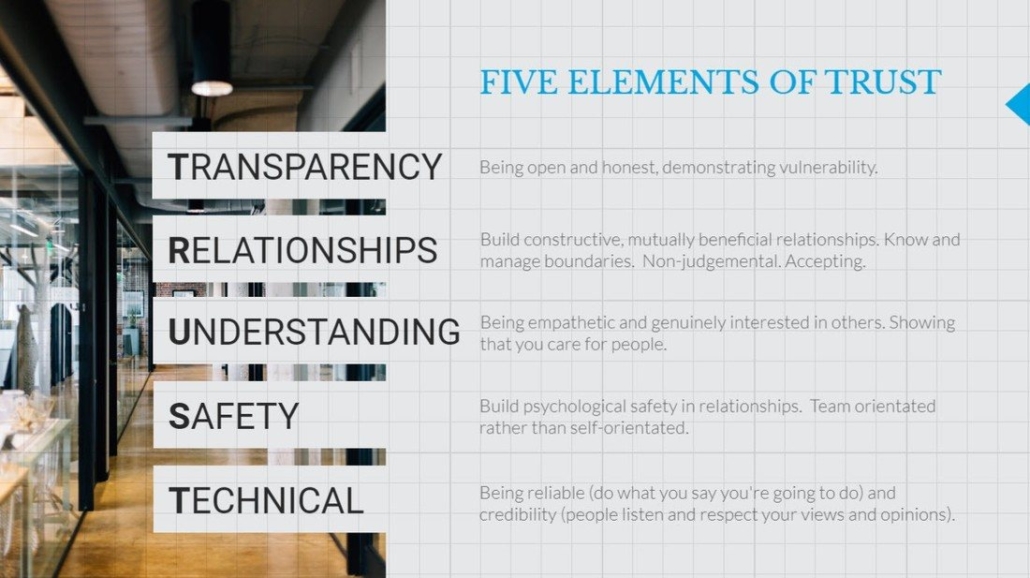
To help leaders better understand trust, I developed a model based on the best available information, research and my own experience in terms of what actually works. This model isn’t the work of an academic, but it is based on solid evidence. Making even small improvements in one or more of the five elements can make a big difference in how trustworthy we are perceived as being.

To borrow a principle from Stephen R. Covey, the speed of trust is directly related to the speed of business. In other words, increased trust means increased speed of business, both in terms of execution, relationships, team dynamics and living a fulfilling life.

Five Elements of Trust: Your Key to Building High-Trust Relationships

As can be seen in the model (below), trust comprises five critical and interdependent elements. Over the coming weeks, I will discuss each in more depth.

Picture

So, Why Can Trust be Hard?

Why is trust hard? Because we are human – full of feelings, aspirations, fears and yes, potential.

…it doesn’t have to be this way – and that despite our ‘humanness’, we can live, lead and love in ways that create high-trust, safe and mutually beneficial relationships where we can each thrive…

Our sweaty little egos create fertile ground for disagreement, conflict and poor behaviour. My contention, however, is that it doesn’t have to be this way – and that despite our ‘humanness’, we can live, lead and love in ways that create high-trust, safe and mutually beneficial relationships where we can each thrive and live fulfilling lives. It just takes a bit of work and the right approach.

I’ll be writing about each element in more detail in the coming weeks. I look forward to continuing the conversation with you.

All the best – Phil

Repost this

Why Can Trust be So Hard?

leadership programs

Ten Features of World Class Development Programs

Ten Features of World Class Development Programs

The times are changing but…

While our world is changing rapidly, it could be argued that our management practices have not kept pace with these changes. In fact, I think we’re trailing badly.

In reality not much has changed in 100 years. The training and development industry largely rehashes old theory and practices and makes the same mistakes. At the most fundamental level however, our overall quality of management and leadership is poor and is based on archaic notions based on the industrial age.

“We should stop trying to make people happy and instead make them better equipped to deal with the challenges of today’s organisations.”

While more than 75% of learners report high levels of satisfaction with learning programs, in our heart of hearts we know that there is no correlation between ‘happy sheets’ and the successful application of program learning and subsequent performance. We should stop trying to make people happy and instead make them better equipped to deal with the challenges of today’s organisations.

We think we’re driving a Ferrari but we’re really driving a vehicle from the 1900’s

Our Top 10 Features / Practices

Our research and practice in learning and development over two decades has allowed us to assemble a ‘top 10’ list that all development programs should at least consider integrating. I’m not suggesting that programs should have all ten, although that goal is certainly achievable (see Actionable Conversations for example). Programs that manage to incorporate many of the practices are more likely to be effective, sustainable and cost-effective.

So here are our top 10….

1. Solid context

Ensure that programs are framed and positioned in a strong context that includes an assessment of the market / external environment, strategy, the customer and the organisation’s vision for the future. Only then can an organisation determine the type of leader it needs and therefore the type of program it should invest in. We should dispense with generic competency based models and generic programs that are not targeted.

2. Just-in-time & strategic

If point #1 is true (above), it also holds true that training should be more agile, responsive and ‘just-in-time’ to meet the specific development needs now and in the short-term. Too often organisations get caught in the trap of looking too far in to the future to try to determine leadership needs. A more pertinent question is to ask ‘What do we need right now and in the coming 12 months?’

3. Leader-led / expert-driven

Developing people should be led internally – harvesting every opportunity, everyday. This should be a blend of informal in-the-moment; semi-structured (e.g. monthly leader-led conversations around a mission critical theme); or more formal training provided by outside experts who can bring a perspective and skills sometimes not present internally.

“Developing people should be led internally – harvesting every opportunity, everyday.”

4. Real-world & practical

Please don’t read ‘real-world’ and practical as just being focused on skill building or superficial training that doesn’t challenge people around their mindsets and behaviours. The most effective development programs invite people to play at their edge. The best programs are transformational, where participants can never view themselves or the world in the same way again (the ANZ Breakout program was a good example of this where I was the head of program delivery between 2001 and 2007).

5. Transfer of learning is primary

Learning can suffer three fatal flaws: (1) it occurs in a vacuum; (2) is not linked to a learner’s role or business unit objectives or (3) learning remains in the classroom. Research tells us that the most important factor in program participants being able to apply their learning back in the workplace is their manager.

6. Supports both leader and learner

We tell our program participants that their 1-up manager should almost feel like they’re going through the program, such should be the level of communication, sharing and support that happens in that relationship. Unfortunately this is more aspirational than fact. Secondly, programs that are leader-led have the added benefit of developing both the team member as well as the leader running the session.

7. Mechanisms to support accountability

I like to call this the ‘scaffolding’ that helps support learners. Examples include regular development meetings with their manager; scheduling time for reflection on behaviours and approach; formal or informal coaching / mentoring; and perhaps most importantly, developing habits and practices (see # 9).

8. Doesn’t break the bank

This perhaps goes without saying, however if programs are going to be rolled out in large volume then they need to be cost-effective and provide a measurable return-on-investment.

9. Focuses on the pathway to get there

One observation I have made repeatedly is that we over-invest in goal setting and under-invest in the pathways to get there. In other words, you can set all the goals you want, but if you don’t have a plan to get there, the goals are useless. And the pathway to get there is through developing habits and practices that move you toward the goal everyday. Read my post on LinkedIn on Habits and Practices.

10. Reinforced & Rewarded

Accountability is an over-used word in organisations, however if you want people to do something different, there has to be accountability built in to development programs. Also, we are all human. In a world that is quick to criticize or cut-down, the basic human need of support and acceptance is enduring. Reward the right behaviours – and oh, don’t forget to reward the right intention and effort.

By at least considering all ten features in this list and how they might be incorporated in your development programs, you stand a very good chance of delivering what you set out to do in the first place, develop people in a way that makes a difference to them and to the organisation.

What to do from here:

  1. Find out more about our leadership development programs.
  2. Subscribe to get valuable content in the future.
  3. Get in contact: Australia: 1300 100 857 or support@theleadershipsphere.com.au

Ten Features of World Class Development Programs

LeadershipSkills MyTop

Leadership Skills – My Top 10

Leadership Skills – My Top 10

The Skills Employers are Looking For Today

What are the top leadership skills sort after by employers? To make this assessment I need to reflect. In 2013, I wrote a chapter in the book “Emerging Trends in Leadership Strategy” entitled The Challenge of the Leadership Gap.

Why the ‘Leadership Gap’?

The reality is that strategy, the execution of strategy and the decisions associated with both functions have become much closer operationally than they were under a more traditional model of management. As strategy has become integral to a leadership / management role, two other things have happened:

1. The context in which strategy is developed has taken on a different shape and is far more complex than in previous times.

2. The responsibility for the execution of strategy has shifted.

Strategy is no longer simply about gathering data on products, customers and competitors. The wider context of the operating environment is now critical to strategic thinking. As well as thinking about industries, markets, competitors and customers, more global and less tangible considerations have become critical to organisational success and profitability. Considerations of the physical environment, political implications and impacts on communities and society more broadly are now just some of the essential elements of the context in which strategy is formulated today.

the leadership gap diagram

Furthermore, as middle management has disappeared and employees have begun to look for meaning in their work, the role of alignment between strategy formulation and the execution of strategy has become a shared responsibility of the senior management team (including the executive) and the rest of the employees in the organisation. As hierarchy has devolved, communication between organisational members – at all levels – has taken on far more complexity and far greater importance. This has led to what I called the ‘leadership gap’ (see figure below).

The (New) Top 10 Leadership Skills Employers Want and Need

Based on the ‘Leadership Gap’ and conversations with dozens of organisations across multiple industries, here is my assessment of the top 10 leadership skills needed (from the ‘outside-‘in’):

1. Eyes ‘Up & Out’

Good leaders have the ability to look outside their own organisation to understand trends in their industry and more broadly, society. They are then able to create a vision (a picture of the future) and mission (purpose) that best serves customers and supports building a strong organisation. Both vision and mission are important. As one of my clients put it (a Catholic-based not-for-profit)…

If there’s no money then there’s no mission!

2. Change Leadership

Leading change is complex because it encompasses virtually everything in our top 10. If leaders aren’t leading change in some shape or form, then they’re probably doing an excellent job managing the status quo. While managing ‘what-is’ is important in terms of producing high quality, reproducible results (think customer service), it is not the main game. True leadership involves mobilising people who are closest to the problem or opportunity and then supporting them to make the necessary changes.

3. ‘Network’ Savvy – Seeing the Whole

image


Many tasked with leadership are too focussed on what’s in front of them rather than being able to think in a ‘joined up’ way. Leaders need to be able to ‘see’ the whole system and understand how it operates in unison. Being savvy means being able to see how the human and mechanical systems (i.e. policies, processes, systems, and structure) work together to create a state of homeostasis – or no change. Being ‘network’ wise will become even more important. As someone once said….

Organisations are perfectly aligned to get the results they get.

4. Politically Savvy

Note that I said ‘politically savvy’, not ‘political’. There is a difference. Building on Leadership Skill 1 (Eyes Up and Out), being politically savvy means understanding the direction and depth of relationships, understanding people’s loyalties (e.g. people, history, ways of doing things, etc.) and finally, understanding the losses we’re asking people and teams to sustain as a result of our change or initiative (e.g. status, resources, money, stability, autonomy, being part of a tribe, etc.).

5. Leading Teams

image

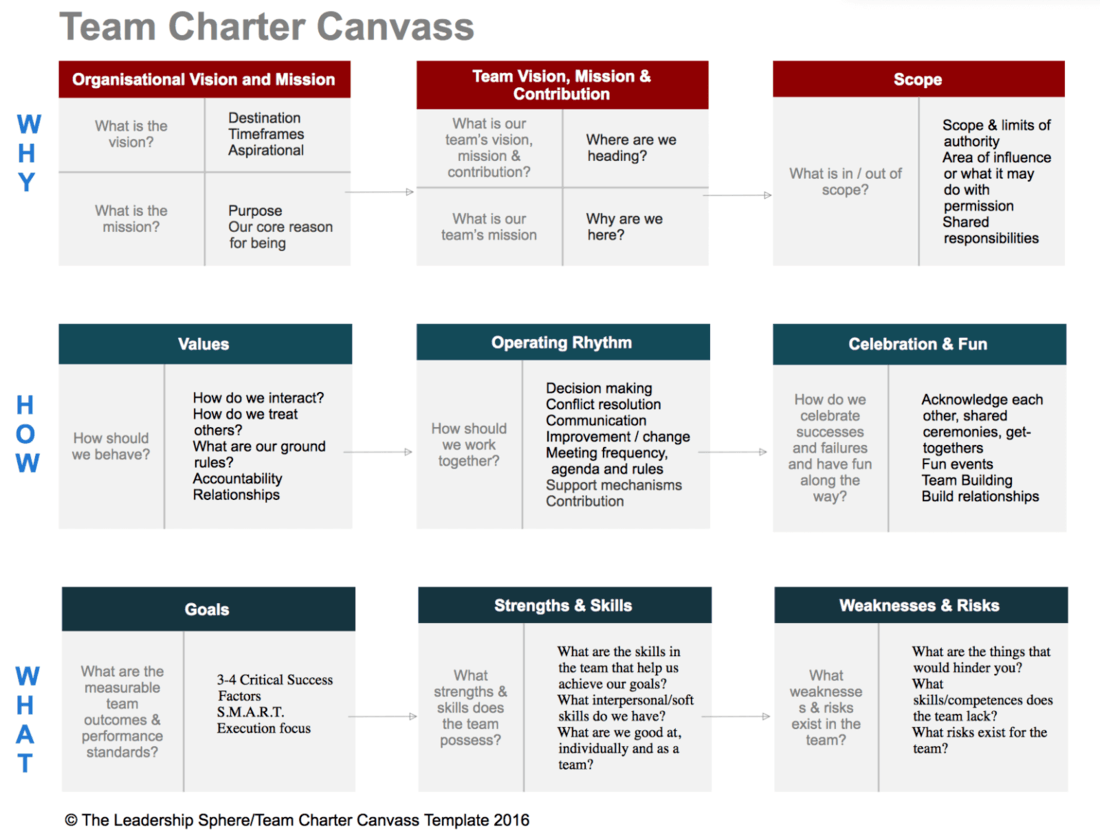
In the future, teams will become even more important. Leaders will need to be able to quickly form a team, separate and re-form faster than ever before to work on discreet parcels of work. Leaders will need the know-how to create a climate of performance and health quickly. In a previous post, I talked about our Team Charter Canvass (below) as a guiding document to do this effectively.

6. Developing People

Developing people could be the most important skill needed for the future. Today, the bias is for action and task completion, rather than growing and developing people. Learning and people’s everyday role functions are still too separated. Leaders will need to think differently by providing learning opportunities at the same time as getting the job done. What would it look like if a minimum of 50% of everything employees did provided a genuine development opportunity? What would be the benefits over time?

7. Building Relationships

It might sound obvious, but the ability to build relationships across functions, silos and diverse interests and agendas can be tricky business. The best build a platform of credibility that comes from being able to achieve results while fostering positive relations. The qualities and skills needed to do this successfully include genuine care for others, empathy and warmth.

8. Trust

Trust is as old as time, but remains fundamental in shaping how we work, live and love. Effective leaders are able to build trust and be trustworthy. Nothing facilitates the speed of business like trust. Good leaders strike a balance between company and personal objectives by being open and transparent, but in the right amounts. It must make sense for the prevailing culture, mood and operating rhythm (e.g. sharing too much information that unnecessarily burden’s people for example).

9. Resilience

Effective leaders have the capacity to bounce back from set-backs and challenges. While they’re not robots by any stretch of the imagination, they have developed personal strategies that move beyond mere survival. In a world where more people are prone to a sense of overwhelm, developing the skills of resilience, particularly a balanced approach to life is vital.

10. Self-Mastery

imageself mastery

Self-mastery is a term that may not be commonly used in business, but it really separates average leaders from the best leaders. While we are tribal in nature as a species, this doesn’t mean we always get along with each other. Unfortunately, we all have egos – and it is our ego that gets in the way of effective leadership. Brene Brown’s research and commentary on vulnerability is insightful. Brown suggests that in a culture of scarcity (that is, feeling we’re not smart enough, thin enough, wealthy enough, etc.), we constantly feel the need to prove to ourselves and others that we are in fact smart, competent, have it all together, etc.

So there you have it – my assessment of the Top 10 Leadership Skills that will best serve organisations now and in to the future. While each of these leader skills requires continuous attention, investment and support, the results for organisations and the communities they serve justifies the effort.

Find out More

We are specialists in powering teams through leadership. If you’re interested in learning more about these programs and how we may be able to work with you to achieve outstanding results, then you can:

Call us on 1300 100 857
Email: support@theleadershipsphere.com.au
Visit: https://theleadershipsphere.com.au/

Leadership Skills – My Top 10