Blog title here

How to Diagnose Team Performance Gaps: People vs. System
How to Diagnose Team Performance Gaps: People vs. SystemTo…


Ask any leader what matters most, and you’ll hear thoughtful answers about strategy, people development, and long-term vision. Then look at their calendar. More often than not, the two tell completely different stories.
This gap between intended focus and actual time spent is one of the most common frustrations in senior leadership. You know what should command your attention, yet the day fills up with meetings, fire-fighting, and tasks that feel urgent but rarely move the organisation forward. By the time you surface, the strategic work you promised yourself you’d tackle has slipped to tomorrow. Again.
The good news? This pattern isn’t a personal failing. It’s a structural problem with structural solutions. In this article, we’ll explore why operational demands crowd out strategic work, unpack the classic framework that explains the trap, and share practical strategies to help you reclaim your time for the work that truly counts.
Picture the daily reality of most leaders. Emails arrive faster than you can clear them. A team member needs a quick decision. A client escalates an issue. A report is due. Each of these tasks feels reasonable on its own, but together they form a current that pulls you away from the deep, strategic thinking your role demands.
This is the operational treadmill. Operational tasks share a few dangerous qualities: they’re visible, they’re measurable, and they offer the quick satisfaction of being ticked off. Strategic work, by contrast, is slow, ambiguous, and rarely rewards you with that same instant sense of progress.
The result is a slow drift. Without realising it, you become the most senior firefighter in the building rather than the architect of where the organisation is heading. The ship stays afloat, but no one is steering it towards the horizon.
The cost is significant. When leaders spend their hours reacting rather than directing, growth stalls, teams lose clarity, and the very initiatives meant to secure the future never get the attention they need.
To understand why this happens, it helps to revisit a principle attributed to Dwight D. Eisenhower. The Eisenhower Matrix sorts tasks along two dimensions: how urgent they are, and how important they are.
The matrix produces four quadrants:
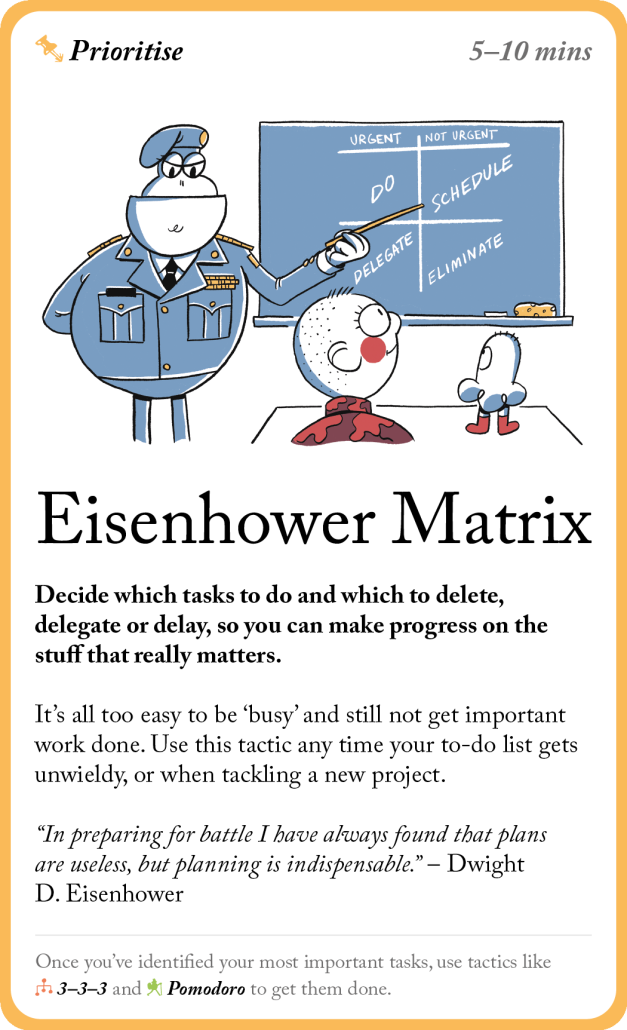
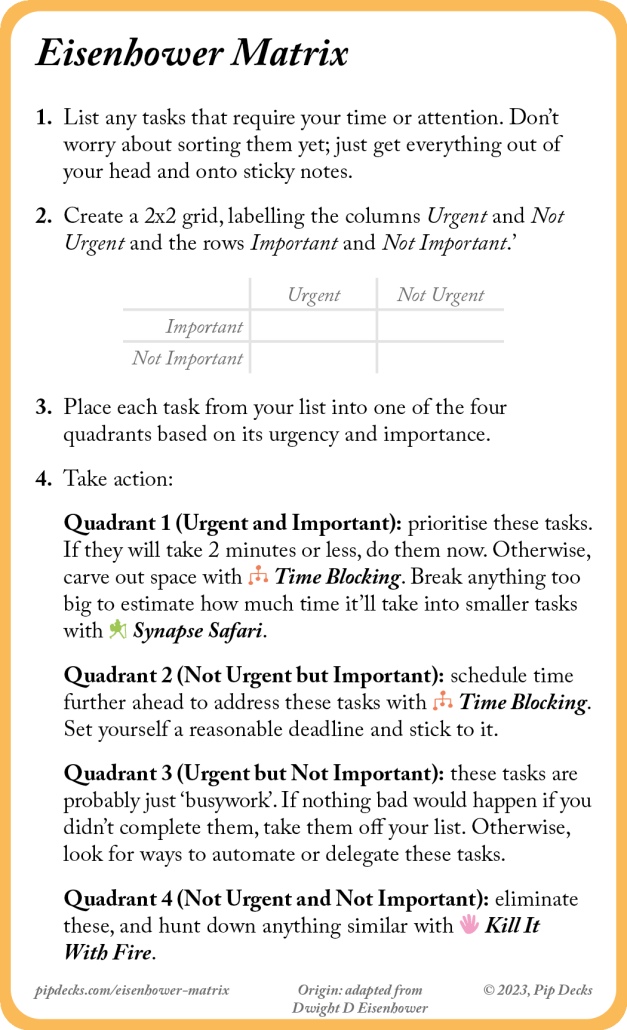
The insight is simple but profound. The work that drives long-term success almost always sits in the “important but not urgent” quadrant. Yet because it lacks a ticking clock, it constantly loses out to tasks that shout louder.
Modern working life has made this challenge worse. Notifications, instant messaging, and the cultural expectation of immediate responses have inflated the “urgent” category beyond all reason. Things that would once have waited now feel as though they need answering this minute. The louder the noise, the harder it becomes to protect the quiet, important work that genuinely shapes the future.
Recognising the problem is one thing. Changing it is another. Realigning your time with your priorities takes deliberate effort and a willingness to do things differently. Here are four strategies that make a real difference.
Every “yes” to something unimportant is an implicit “no” to something that matters. Leaders who guard their time learn to decline requests gracefully but firmly.
Saying “no” doesn’t mean being unhelpful; it means being clear about your capacity and priorities. A simple, “I can’t take that on right now, but here’s who might help,” protects your focus while still supporting others. As you advance, your calendar becomes a direct reflection of what you value. An essential part of senior leadership development is learning to treat each commitment as a deliberate choice, not a reflex, ensuring your time is invested where it matters most.
Strategic work needs protected space. Time blocking is the practice of reserving specific periods in your calendar for focused, uninterrupted thinking, and then defending those blocks as fiercely as you would an important meeting.
Choose the hours when your energy is highest. For many people, that’s the first part of the morning before the day’s demands take hold. Turn off notifications, close your inbox, and treat that time as non-negotiable. A few hours of genuine deep work each week can produce more meaningful progress than an entire month of fragmented attention.
Much of what fills a leader’s day could be done by someone else, often better. Delegation isn’t simply offloading tasks, it’s a development tool that builds capability across your team while freeing you for higher-value work.
Effective delegation means handing over responsibility along with the authority and trust to act. A core principle taught in leadership development training is to resist the urge to take work back the moment something isn’t done exactly as you would have done it. When you empower people to own outcomes, you multiply your impact and create room for the strategic thinking only you can do.
Delegation works best when you understand who’s best suited to what. This is where leadership assessment and profiling tools earn their place. By revealing the strengths, working styles, and motivations of your team members, these tools help you match tasks to people far more effectively.
Assessment and profiling tools give you a clearer picture of where each person thrives. Perhaps one team member excels at detail-oriented analysis while another energises a room and builds relationships. Armed with these insights, you can delegate with confidence, knowing you’re playing to genuine strengths rather than guessing. The result is better outcomes, more engaged people, and a leader who can finally step back from the operational detail.
Perhaps the most powerful way to reclaim your calendar is through team coaching. Team coaching moves beyond delegation and sets the expectation for teams to truly take ownership of their roles. It creates a framework where the team collaborates to find solutions, manage their own workflows, and hold each other accountable.
This is why team coaching is important: it fosters a culture of proactive problem-solving and shared responsibility. As your team becomes more self-sufficient, they will rely on you less for day-to-day operational guidance, freeing up your time to focus on high-level strategic leadership.
Your calendar is the clearest evidence of your real priorities, regardless of what you say you value. When the two don’t match, it’s a signal worth heeding. It’s not a reason for guilt, but a prompt for change.
Start small. Block out two hours next week for strategic thinking and protect them without exception. Practice declining one low-value request. Identify a single task you can delegate, and a team member ready to grow into it. These modest steps build momentum, and momentum is what eventually transforms how you spend your days.
The deeper shift comes when you stop trying to fix everything alone. By coaching your team to higher performance, you create the conditions that let strategic work flourish. Understanding your team’s strengths through assessment and profiling tools turns delegation from a gamble into a strategy.
Change your calendar, and you change your leadership. The work that truly moves your organisation forward is waiting; it just needs you to make the space for it.

 https://theleadershipsphere.com.au/wp-content/uploads/2026/10/2610_004-Blog.png
1080
1920
Phillip Ralph
https://theleadershipsphere.com.au/wp-content/uploads/2021/09/TLS_Blue-Grey-Horizontal-300x124-fix.png
Phillip Ralph2026-10-20 08:00:202026-10-21 17:26:29Why Strategy Fails at the Execution Stage
https://theleadershipsphere.com.au/wp-content/uploads/2026/10/2610_004-Blog.png
1080
1920
Phillip Ralph
https://theleadershipsphere.com.au/wp-content/uploads/2021/09/TLS_Blue-Grey-Horizontal-300x124-fix.png
Phillip Ralph2026-10-20 08:00:202026-10-21 17:26:29Why Strategy Fails at the Execution Stage https://theleadershipsphere.com.au/wp-content/uploads/2026/10/2610_003-Article-scaled.jpg
1707
2560
Phillip Ralph
https://theleadershipsphere.com.au/wp-content/uploads/2021/09/TLS_Blue-Grey-Horizontal-300x124-fix.png
Phillip Ralph2026-10-15 08:00:512026-10-16 09:49:25Transforming Leadership Challenges into Opportunities
https://theleadershipsphere.com.au/wp-content/uploads/2026/10/2610_003-Article-scaled.jpg
1707
2560
Phillip Ralph
https://theleadershipsphere.com.au/wp-content/uploads/2021/09/TLS_Blue-Grey-Horizontal-300x124-fix.png
Phillip Ralph2026-10-15 08:00:512026-10-16 09:49:25Transforming Leadership Challenges into Opportunities https://theleadershipsphere.com.au/wp-content/uploads/2021/09/TLS_Blue-Grey-Horizontal-300x124-fix.png
0
0
Phillip Ralph
https://theleadershipsphere.com.au/wp-content/uploads/2021/09/TLS_Blue-Grey-Horizontal-300x124-fix.png
Phillip Ralph2026-10-13 08:00:092026-10-14 15:03:56How to Diagnose Team Performance Gaps: People vs. System
https://theleadershipsphere.com.au/wp-content/uploads/2026/10/2610_002-Article-scaled.jpg
1707
2560
Phillip Ralph
https://theleadershipsphere.com.au/wp-content/uploads/2021/09/TLS_Blue-Grey-Horizontal-300x124-fix.png
Phillip Ralph2026-10-08 08:00:002026-10-15 11:35:51Why Capable Teams Still Depend on Their Leaders
https://theleadershipsphere.com.au/wp-content/uploads/2026/10/2610_004-Blog.png
1080
1920
Phillip Ralph
https://theleadershipsphere.com.au/wp-content/uploads/2021/09/TLS_Blue-Grey-Horizontal-300x124-fix.png
Phillip Ralph2026-10-20 08:00:202026-10-21 17:26:29Why Strategy Fails at the Execution Stage
https://theleadershipsphere.com.au/wp-content/uploads/2026/10/2610_003-Article-scaled.jpg
1707
2560
Phillip Ralph
https://theleadershipsphere.com.au/wp-content/uploads/2021/09/TLS_Blue-Grey-Horizontal-300x124-fix.png
Phillip Ralph2026-10-15 08:00:512026-10-16 09:49:25Transforming Leadership Challenges into Opportunities
https://theleadershipsphere.com.au/wp-content/uploads/2021/09/TLS_Blue-Grey-Horizontal-300x124-fix.png
0
0
Phillip Ralph
https://theleadershipsphere.com.au/wp-content/uploads/2021/09/TLS_Blue-Grey-Horizontal-300x124-fix.png
Phillip Ralph2026-10-13 08:00:092026-10-14 15:03:56How to Diagnose Team Performance Gaps: People vs. System
https://theleadershipsphere.com.au/wp-content/uploads/2026/10/2610_002-Article-scaled.jpg
1707
2560
Phillip Ralph
https://theleadershipsphere.com.au/wp-content/uploads/2021/09/TLS_Blue-Grey-Horizontal-300x124-fix.png
Phillip Ralph2026-10-08 08:00:002026-10-15 11:35:51Why Capable Teams Still Depend on Their Leaders
https://theleadershipsphere.com.au/wp-content/uploads/2021/09/TLS_Blue-Grey-Horizontal-300x124-fix.png
0
0
Phillip Ralph
https://theleadershipsphere.com.au/wp-content/uploads/2021/09/TLS_Blue-Grey-Horizontal-300x124-fix.png
Phillip Ralph2026-10-13 08:00:092026-10-14 15:03:56How to Diagnose Team Performance Gaps: People vs. System
https://theleadershipsphere.com.au/wp-content/uploads/2026/10/2610_002-Article-scaled.jpg
1707
2560
Phillip Ralph
https://theleadershipsphere.com.au/wp-content/uploads/2021/09/TLS_Blue-Grey-Horizontal-300x124-fix.png
Phillip Ralph2026-10-08 08:00:002026-10-15 11:35:51Why Capable Teams Still Depend on Their Leaders
https://theleadershipsphere.com.au/wp-content/uploads/2026/10/2610_004-Blog.png
1080
1920
Phillip Ralph
https://theleadershipsphere.com.au/wp-content/uploads/2021/09/TLS_Blue-Grey-Horizontal-300x124-fix.png
Phillip Ralph2026-10-20 08:00:202026-10-21 17:26:29Why Strategy Fails at the Execution Stage
https://theleadershipsphere.com.au/wp-content/uploads/2026/10/2610_003-Article-scaled.jpg
1707
2560
Phillip Ralph
https://theleadershipsphere.com.au/wp-content/uploads/2021/09/TLS_Blue-Grey-Horizontal-300x124-fix.png
Phillip Ralph2026-10-15 08:00:512026-10-16 09:49:25Transforming Leadership Challenges into Opportunities
https://theleadershipsphere.com.au/wp-content/uploads/2021/09/TLS_Blue-Grey-Horizontal-300x124-fix.png
0
0
Phillip Ralph
https://theleadershipsphere.com.au/wp-content/uploads/2021/09/TLS_Blue-Grey-Horizontal-300x124-fix.png
Phillip Ralph2026-10-13 08:00:092026-10-14 15:03:56How to Diagnose Team Performance Gaps: People vs. System
https://theleadershipsphere.com.au/wp-content/uploads/2026/10/2610_002-Article-scaled.jpg
1707
2560
Phillip Ralph
https://theleadershipsphere.com.au/wp-content/uploads/2021/09/TLS_Blue-Grey-Horizontal-300x124-fix.png
Phillip Ralph2026-10-08 08:00:002026-10-15 11:35:51Why Capable Teams Still Depend on Their Leaders