Blog title here

How to Diagnose Team Performance Gaps: People vs. System
How to Diagnose Team Performance Gaps: People vs. SystemTo…


The disconnect between strategy and execution ranks among the most persistent challenges leaders face. A well-crafted plan emerges from months of analysis, workshops, and careful deliberation. Everyone nods in agreement during the launch meeting. Then, within weeks, the strategic priorities quietly slip down the list.
Where most organisations fail is in the unravelling of strategy once daily operations kick back in. So the question isn’t really “why does strategy execution fail?” It’s “what happens in the weeks after launch that decides whether a strategy lives or dies?”
That matters because the cost of failed execution rarely shows up until it’s too late. Budgets get spent, timelines slip, and leaders are left wondering why a perfectly sound plan never delivered results. When you understand the root cause, you can change how you prepare for strategic change, and how you keep it going.

Strategic plans often collapse under the weight of ordinary business life. Once the launch excitement fades, daily operations reclaim leaders’ attention, and strategic priorities get quietly deprioritised in favour of whatever feels urgent that week.
This happens for a few consistent reasons:
Teams lack clarity on how strategy connects to their work. A strategic objective sitting in a slide deck means little to someone managing a customer complaint or a production delay. Without a clear line between daily tasks and strategic goals, employees default to what’s immediately in front of them.
Leadership attention fragments. Senior leaders are pulled in multiple directions at once. Strategic initiatives compete with performance reviews, client escalations, and budget meetings. So strategy rarely wins that contest because its costs are long-term while operational problems are immediate.
Resources drift towards firefighting. Budgets and staff time originally earmarked for strategic projects get reallocated to urgent operational issues. Over time, the strategic initiative is starved of the resources it needs to gain momentum.
None of these causes reflect a flawed strategy. They reflect an organisation that hasn’t built the structures needed to protect strategic work once it leaves the planning room.
Executing strategy demands a different skill set than creating it. Crafting strategy rewards analytical thinking, pattern recognition, and the ability to see the bigger picture. Executing it demands discipline, accountability, and the ability to manage competing priorities under pressure, day after day.
Many senior leaders have never been formally trained in execution disciplines. They’re promoted for strategic thinking, market insight, or technical expertise, not for their ability to drive sustained, accountable delivery across a team or division. This is precisely the gap that senior leadership development needs to address.
High performance leadership requires more than setting direction. It requires building accountability systems, adapting plans as circumstances shift, and maintaining focus on priorities even when operational noise is loud. Without these capabilities, even the best strategy will stall.
This is why executive leadership training focused specifically on strategy-to-execution capability has become so important. Leaders need frameworks for maintaining focus, not just frameworks for setting direction.
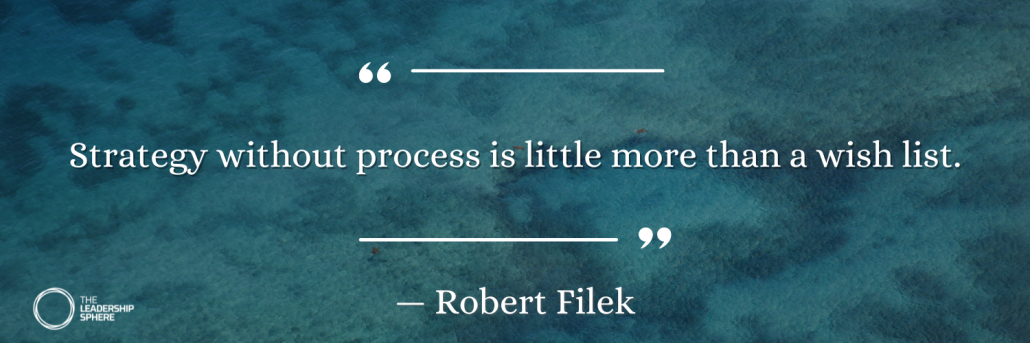
Closing the gap between strategy and execution takes more than just trying harder. It’s about building the right structures and capabilities from the outset. Consider the following approach:
Define clear, measurable outcomes. Vague strategic goals invite vague effort. Tie every strategic objective to specific, measurable outcomes so progress can be tracked and setbacks spotted early.
Align incentives with strategic priorities. If performance metrics and bonuses reward only operational output, don’t expect teams to prioritise strategic work. Incentive structures need to reflect what the organisation actually wants people to focus on.
Build disciplined execution rhythms. Regular, structured progress reviews keep strategic initiatives visible and accountable. Without this rhythm, strategic projects quietly fade from view within a quarter.
Invest in leadership development focused on execution. Leadership development programs should go beyond strategic thinking and teach the practical disciplines of execution: prioritisation, accountability conversations, and adaptive management under pressure.
Strengthen senior leadership development around accountability. Senior leaders set the tone for the whole organisation. When they model accountability for strategic commitments, that behaviour cascades through every level below them.
Choose to invest in execution training if your organisation regularly sees strong strategies fail to gain traction after launch. Revisit the strategy itself if the plan was unclear or unrealistic from the start. But in most cases, it’s the execution muscle that needs strengthening, not the strategic vision.
Strategy execution failure is rarely a strategy problem. It’s a leadership development issue, and treating it as one changes how you approach the solution.
Organisations that invest deliberately in leadership development see markedly higher execution rates, because their leaders have the skills, structures, and accountability systems needed to sustain strategic focus once the initial momentum fades.
The gap between strategy and execution can be closed. It takes intentional focus, the right leadership development programs, and a willingness to treat execution as a discipline worth investing in, just as much as strategy itself. Start by asking where your organisation’s strategic initiatives tend to lose steam. That’s where your leadership development efforts should begin.
 https://theleadershipsphere.com.au/wp-content/uploads/2026/10/2610_004-Blog.png
1080
1920
Phillip Ralph
https://theleadershipsphere.com.au/wp-content/uploads/2021/09/TLS_Blue-Grey-Horizontal-300x124-fix.png
Phillip Ralph2026-10-20 08:00:202026-10-21 17:26:29Why Strategy Fails at the Execution Stage
 https://theleadershipsphere.com.au/wp-content/uploads/2026/10/2610_003-Article-scaled.jpg
1707
2560
Phillip Ralph
https://theleadershipsphere.com.au/wp-content/uploads/2021/09/TLS_Blue-Grey-Horizontal-300x124-fix.png
Phillip Ralph2026-10-15 08:00:512026-10-16 09:49:25Transforming Leadership Challenges into Opportunities
 https://theleadershipsphere.com.au/wp-content/uploads/2021/09/TLS_Blue-Grey-Horizontal-300x124-fix.png
0
0
Phillip Ralph
https://theleadershipsphere.com.au/wp-content/uploads/2021/09/TLS_Blue-Grey-Horizontal-300x124-fix.png
Phillip Ralph2026-10-13 08:00:092026-10-14 15:03:56How to Diagnose Team Performance Gaps: People vs. System
https://theleadershipsphere.com.au/wp-content/uploads/2026/10/2610_002-Article-scaled.jpg
1707
2560
Phillip Ralph
https://theleadershipsphere.com.au/wp-content/uploads/2021/09/TLS_Blue-Grey-Horizontal-300x124-fix.png
Phillip Ralph2026-10-08 08:00:002026-10-15 11:35:51Why Capable Teams Still Depend on Their Leaders
https://theleadershipsphere.com.au/wp-content/uploads/2026/10/2610_004-Blog.png
1080
1920
Phillip Ralph
https://theleadershipsphere.com.au/wp-content/uploads/2021/09/TLS_Blue-Grey-Horizontal-300x124-fix.png
Phillip Ralph2026-10-20 08:00:202026-10-21 17:26:29Why Strategy Fails at the Execution Stage
https://theleadershipsphere.com.au/wp-content/uploads/2026/10/2610_003-Article-scaled.jpg
1707
2560
Phillip Ralph
https://theleadershipsphere.com.au/wp-content/uploads/2021/09/TLS_Blue-Grey-Horizontal-300x124-fix.png
Phillip Ralph2026-10-15 08:00:512026-10-16 09:49:25Transforming Leadership Challenges into Opportunities
https://theleadershipsphere.com.au/wp-content/uploads/2021/09/TLS_Blue-Grey-Horizontal-300x124-fix.png
0
0
Phillip Ralph
https://theleadershipsphere.com.au/wp-content/uploads/2021/09/TLS_Blue-Grey-Horizontal-300x124-fix.png
Phillip Ralph2026-10-13 08:00:092026-10-14 15:03:56How to Diagnose Team Performance Gaps: People vs. System
https://theleadershipsphere.com.au/wp-content/uploads/2026/10/2610_002-Article-scaled.jpg
1707
2560
Phillip Ralph
https://theleadershipsphere.com.au/wp-content/uploads/2021/09/TLS_Blue-Grey-Horizontal-300x124-fix.png
Phillip Ralph2026-10-08 08:00:002026-10-15 11:35:51Why Capable Teams Still Depend on Their Leaders