Posts

Vulnerability in Leadership

Vulnerability in Leadership: More than just a Buzzword? (Part 2)

Vulnerability in Leadership: More than just a Buzzword? (Part 2)

In part 1 of this two-part article, “Vulnerability in Leadership: More than Just a Buzzword, I discussed vulnerability as a key leadership strength.  It’s an idea and principle that is increasingly referenced in leadership literature and in organisations. Despite this growing awareness, vulnerability is still usually associated with weakness. That’s unfortunate – because vulnerability is such a critical leadership quality that it deserves serious attention.

I also mentioned in part 1 that I, like many others, stand on the shoulders of giants like Dr Brown. I’m very excited to be heading to the US in November to complete the Dare to Lead accreditation program.  In it we will further explore concepts such as courage, vulnerability, shame, the gifts of imperfection, rising strong and brave, and deeper hearts and minds work. I look forward to sharing the learnings with clients here in Australia and abroad to develop effective leadership skills.

In part 1, we look at ‘what’ (what is vulnerability?) and ‘why’ (why we should care about vulnerability in leadership). In this article, we will focus on the ‘how’ – how to be a more effective leader by being more open, authentic and vulnerable.

Top Five Reasons We Should Care About Vulnerability

In summary, the business case for vulnerability is around five key benefits:

  1. Connection – In a technology-centric world, vulnerability allows us to connect with others, build stronger relationships and enhance job performance.
  2. Trust – Trust is an essential component of business effectiveness. High trust organisations experience 32x greater risk-taking, 11x more innovation, and 6x higher performance. (Edelman Trust Barometer)
  3. Innovation – You can’t have innovation without vulnerability. Most leaders know that innovation is good for business, but many still struggle to create nimble, agile and innovative cultures.
  4. To Partner is to Lead – If you want to create change in your organisation then you need to be more ‘leader’ than ‘manager’, and more ‘partner’ than leader. Learning to share power and leadership at the right times can release dormant potential within teams and organisations.
  5. Building Learning, Growth and Resilience – One of our primary tasks as leaders is to grow and develop confident, capable and resilient people into high-performance teams. Learning inherently requires vulnerability – taking ourselves outside our comfort zone.  If you’re not open and vulnerable, then you’re probably not learning.
The Being-Doing Paradox

Before we discuss how to be a more effective leader by being more open, authentic and vulnerable, it might be useful to explore being versus doing.

The Being-Doing Paradox is that to get more done (e.g. task accomplishment at work), we can often be trapped into believing that we must do more things. In our minds at least, we often seem to correlate doing with productivity. It’s what Michael Bungay Stainer calls ‘busy work’ rather than ‘good’ or ‘great work’. When we’re honest with ourselves though, we know that sometimes we are busy being busy with nothing much to show for it. Sound familiar?

The busy-ness epidemic has grown over the top of us like mould. It has kind of just crept up on us. The problem is that the ‘mould’ is now starting to block some of the sunlight. I have written about this before, but I continue to see people working harder and longer. I’m often left wondering when something will give. What will be the wake-up call for you and your organisation?

My belief is that if we want to be more productive, then we need to be less busy. We need to re-connect with being human rather than being busy.

There is a great article I often reference from James Galvin and Peter O’Donnell (Authentic Leadership: Balancing Doing and Being), that uses the metaphor of a tree. Unless we attend to the roots of the tree (i.e. Self, Framing, Character, and Alignment), then we will be weakened and severely buffeted by the strong winds of change (i.e. the branches and leaves). Ultimately, this will impact on our ability to effectively deploy our Self, our Skills, Practices, and Behaviours in a meaningful way (see diagram below).

Source: James Galvin and Peter O’Donnell (Authentic Leadership: Balancing Doing and Being), Systems Thinker, April 2005.

How Do We Nurture and Develop Vulnerability

An essential part of being able to benefit from vulnerability-based leadership is to be authentically vulnerable. While this may sound obvious, it’s worth re-stating.

To show genuine vulnerability, we have to be comfortable to be genuinely vulnerable – not put on a half-hearted show for the crowd. We must work on the roots of the tree for the trunk, branches, and leaves to be at their best.

Five Stages of Vulnerability: A Practical Guide to Brave Leadership

Based on our understanding of current thinking in the literature and our own experience coaching and consulting with leaders for more than two decades, we have formulated the Five Stages of Vulnerability.

The stages should be viewed more as ‘guides’ rather than empirically based development stages. They serve as a useful metaphor none-the-less.

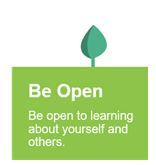
Be Open

The first step in improving our capacity for vulnerability is to Be Open to the idea that we can always learn new things about ourselves (in particular) and about others. When working with leaders in our High-Performance Team Program, the biggest block in making progress is to think we have it all worked out.

Three things to improve openness:

  1. Feedback: Always look for opportunities to get real-time, meaningful feedback from trusted sources (as Brené Brown would say, not from people who like to occupy the ‘cheap seats’!).
  2. Assumptions: Assumptions hurt you and me. The only assumption we can safely make is that we don’t have all the information or data. It continues to amaze me how frequently people make a statement of ‘truth’, and because no-one responds or challenges them, they assume that everyone agrees!
  3. Curiosity: Curiosity didn’t kill the cat. If we want to learn about others, we must put ourselves out there. Be genuinely curious and actively find out about people’s stories. Ask questions and then listen, really listen.
Share More

The principle of Share More is linked to the first stage, Be Open. Sharing is caring. However, this is often one of the most misunderstood aspects of vulnerability. many people think it means lying on a couch and opening up about your childhood or life traumas. Share more of yourself – go beyond pleasantries and the expected. Lower your armour enough so you can show up authentically.

Three things to improve sharing more:

  1. Armour Down: This is the opposite of ‘armour up’. We need to drop the armour just enough for people to be able to see more of who we are. Let them in a bit more than you usually would. Admit you don’t know the answer to a business challenge, or that you too suffer from uncertainty from time to time.
  2. Be Honest: Being honest sounds like it is a given, but is it? When was the last time you withheld information at work (when you didn’t need to)? Or when did you tell a white lie to protect yourself or someone else? Speak the truth with authenticity and courage. As Brown would say, brave the wilderness.
  3. Generosity of Spirit: Being generous is like gift-giving for free – the other person gets the gift, but it doesn’t cost you anything. It’s a win-win. If we can give more and expect less, then we’ll each ultimately receive more anyway (kind of like the ‘circle of life’?).
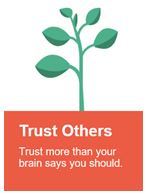
Trust Others

Trust, by its very definition, means taking a risk. I’m not talking about risks where you put yourself and others in great danger. I’m talking about risks that you might ‘logically’ ordinarily reject. For example, I like the quote from the movie “We Bought a Zoo”, where Benjamin Mee (the Dad played by Matt Damon) says to his 14-year old son Dylan (played by Colin Ford), who was apprehensive about showing his true feelings for a girl says, “Sometimes you just need 20 seconds of insane courage”.

Three things to improve trusting others:

  1. Trust Others: We often talk about trusting others in our teams or other colleagues, but how much do we demonstrate it?(I write in more detail on this in my book Leadership Without Silver Bullets). Our inability to trust people as much as we could is a hangover from the industrial, mechanistic age where we discovered control as a management tool.Does control work? Yes. Are there better alternatives? Yes. Free people up from traditional organisational constraints to innovate and be their best. If they don’t do their job or don’t do it well, then it’s our job to guide, coach and develop them, so we can genuinely hold them accountable instead of blaming and shaming.
  2. Change Your Relationship to Failure: As much as we protest in organisations that we encourage innovative, agile practices which are more iterative than structured, I call BS on it. All organisations – or human systems – send double messages. Failure is a good example where the messaging is ‘failure is okay’ but when it happens, watch how the system reacts. As a leader, how do you come across when something goes wrong?
  3. Defy Logic: This requires us to over-ride the ‘caution circuit breaker’. What if it doesn’t work out and I’m embarrassed? Within reason, do it anyway. Put yourself out there by having a go. Most of the time, others will feed off your courage and come along for the ride.
Take Risks

Take Risks sounds like Trust Others (above), but it’s more than that. This is personal. It’ what David Maister talks about in his trust formula (Trust = Credibility + Reliability + Intimacy / Self-Orientation).

People trust others with whom they feel comfortable discussing difficult agendas. Business can be intensely personal – and human emotion is an integral part of just about everything we do. Establishing intimacy is about building and accepting mutually increasing levels of risk in a relationship.

Three things to improve taking risks:

  1. Risk a Little-Gain a Lot: Taking risks means that you will fail. You will fall. And you will end up with egg on your face. But isn’t that what ‘risk’ means?Sometimes the risk-reward relationship may not be so clear, not easily plotted on a graph, but do it anyway. Risk doesn’t mean putting others in harm’s way or abandoning them. They must feel like they’re still supported. My father-in-law talks about being ‘taught’ how to swim by being thrown into the deep end of the pool and having to struggle back to the edge – that’s not what we want to do to others.
  2. Set Boundaries: It is important to maintain boundaries when we’re taking more risks by being open, trusting more, and putting ourselves out there. This means setting boundaries for ourselves and others. How much autonomy will you give someone? How much will you share? How much of your personal story will I disclose?
  3. Be the First: Extend trust – first. The primitive part of our brain wants to protect us physically (will this lion eat me?) and psychologically (is it safe for me to….?). It is therefore very easy to wait for others to extend trust or right wrongs in the relationship.However, try going first. Don’t wait for others. Extend trust as often as possible, including in a fractured relationship. Have the conversation. Mend the rift. Move forward.

Stay On Track doesn’t mean stagnate. It means continually investing in understanding the impact we have on others. We need to be continually self-monitoring and seeking feedback from those around us. Like any relationship that we care about, we can’t ‘set and forget’ vulnerability. The moment we do that, the universe is likely to give us a nasty reminder that this stuff requires constant attention.

Importantly, we can only help others grow if we are also growing. We need to be humble enough to understand – and believe – that we can learn from anyone and everyone. I discovered more about myself raising three children than I did from 100 personal development courses!

Three ways to stay on track:

  1. Continue to Invest in Yourself: Do the work. Remain curious. Don’t buy into the BS that you ‘can’t teach a dog new tricks’. This is a convenient story that we tell ourselves to keep us in the cheap seats and out of the arena. It avoids confronting things we may not like about ourselves, and particularly things that others don’t find to be a positive quality or behaviour.
  2. Encourage & Support Others: Good leaders work hard to create the conditions for others to feel they can take ever-increasing risks. People watch your every move as a leader. They are taking their cues from you in terms of how they respond in the moment to someone who is being vulnerable. We must demonstrate that we have their back. If they cross a boundary, then point it out with skill and compassion.
  3. Psychological Safety: Consciously work to build an environment where people feel safe to voice their opinions, to say what they’re thinking and feeling, or to take reasonable risks. Your legacy as a leader shouldn’t be limited to how many projects you delivered or the results you achieved. Your true legacy as a leader is the culture you created and leave behind.

In this article, we briefly recapped the importance of vulnerability (discussed in detail in part 1 of this two-part paper “Vulnerability in Leadership: More than Just a Buzzword). In particular, its role in building connection, trust, innovation, partnership as leadership and growing and developing people.

We used the Being-Doing Paradox – the paradox that describes how our tendency to work on doing more, taking us away from being more, degrades our productivity.

With the groundwork in place, we introduced the five stages – or more accurately guideposts – to build and develop our capacity and capability to be a more effective vulnerability-based leader.

The five stages of Be Open; Share More; Trust Others; Take Risks and Stay on Track provide a framework to continue the lifelong journey of becoming the best version of ourselves. This builds our capability to make a difference in the lives of those around us – in our teams, organisations, schools, communities, and families.

Vulnerability in Leadership: More than just a Buzzword? (Part 2)

People standing together at sunset

Exploring Transparency

Exploring Transparency

In Part One of this six-part series, we explored trust in the context of organisations and in society generally, and how hard it can fee; sometimes, this is despite trust being at the heart of every relationship, whether in our personal lives or at work. Perhaps alarmingly, 82% of people say they don’t trust their boss to tell the truth, and 45% of employees say lack of trust in leadership is the biggest issue impacting their work performance (Edelman Trust Barometer). In contrast, high trust organisations experience 32x greater risk-taking, 11x more innovation, and 6x higher performance. And at a human level, treating each other with respect and forming good relationships feels like the right thing to do.

Trust as a Multi-Dimensional Construct

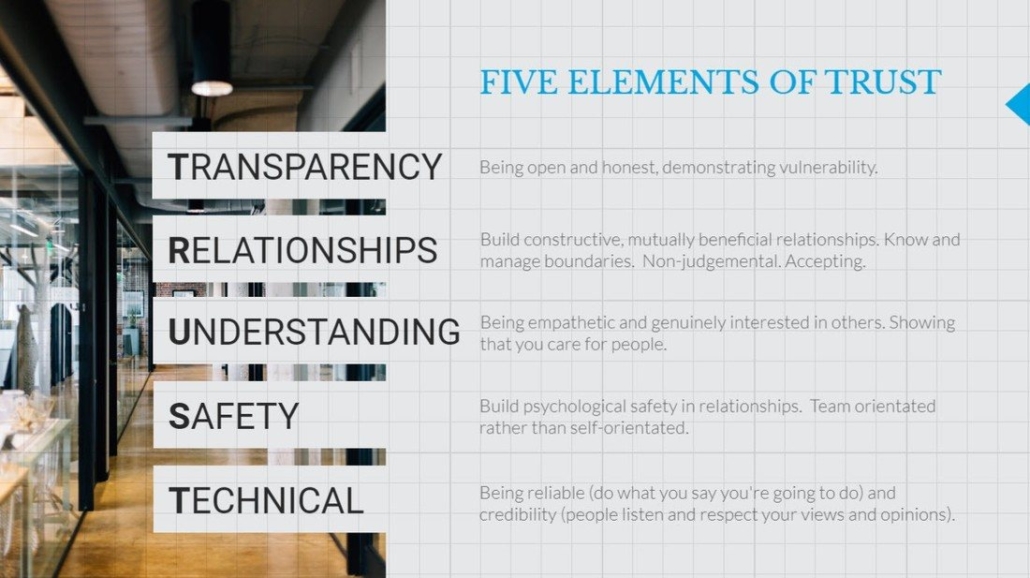
In Part One, we also introduced a model based on the best available information, research and my own experience in terms of what actually works. This model isn’t the work of an academic, but it is based on solid evidence. Making even small improvements in one or more of the five elements can make a big difference in how trustworthy we are perceived as being.

Five Elements of Trust.

In Part Two, we are going to explore transparency, which at its core, it about being open and honest and demonstrating vulnerability.

Whenever I ask people what they look for in a leader, almost without exception, they say openness and honesty. Nothing destroys trust quicker than people thinking that you’re hiding information, being guarded, or if people think you’re in it for yourself. People want to know the truth.

How to be Transparent and Honest

This is where emotional intelligence really comes in to play. While there are lots of definitions to do with emotional intelligence (or EQ), the simplest is that means we can regulate and use our emotions intelligently. This isn’t a course about EQ, so we won’t go in too much detail here, but EQ is a topic that has been written about extensively.

Six Strategies to Become More Transparent

I want to now focus on what you can do to build the ‘Transparency muscle’ – that is, become more effective at this element of trust.

#1 – Be Honest: I know this sounds obvious, but I’m surprised how many times people feel conflicted around this. Yes, be honest, but with skill – be sensitive to the time and place as well as how the message is delivered. Sometimes people wear honesty as a badge and are therefore too direct to the point of being blunt with little consideration for the potential damage done to the person hearing the message. We don’t need to walk on rice paper, but we do need to be constructive.

#2 – Be Prepared: We have recently worked with a high profile organisation here in Australia that has been plagued by bullying and sexual harassment. One of the problems is people not being open, honest and transparent about how certain behaviours were affecting them. We worked with several small groups of senior leaders and provided some guidance on how they might ‘call’ inappropriate behaviour. We essentially armed them with a kit bag full of phrases that would be helpful in the moment. The phrases focused on getting the message across clearly but not in a way that was passive or hostile.

#3 – Give Feedback Regularly: Be transparent by giving constructive feedback and positive feedback often, so people understand where you’re coming from and what your expectations are. By doing this, people will understand what you’re thinking or feeling about a situation.

#4 – Admit Mistakes: You can also be transparent by admitting mistakes and being vulnerable with others. This shows that you’re not perfect either, and it’s a great way to show people that they can trust you. It’s not about sharing all your deepest, darkest fears or every mistake you’ve ever made, so be strategic about what and when you share your mistakes. If you make one in the moment / present day, speak up early and move on. By being an example for your team, they will learn to be more transparent with you and one another.

#5 – Express your opinions: This is one of the best ways to build trust with your team – simply say what’s on your mind – with skill. As I talked about earlier, we need to think about the what, when and how, but as a general principle, don’t be afraid to say what you’re thinking about a conversation or other situation. In our leadership programs, I call this a leadership superpower! Not just blurting out the first thing that comes into your mind but expressing a perspective that will help the team move forward. Sometimes this might feel like a hand-grenade thrown into the middle of the group – an intentional provocative statement or question to get them to think differently.

#6 – Practice Vulnerability: I have recently written an article on leadership and vulnerability, so I will provide a summary here. In my own leadership practice, it is hard to describe the immediate impact vulnerability has on a group of leaders or a team. Recently, I was working with a leadership team as part of our High-Performance Team program, where the impact of one person demonstrating vulnerability was immediate. In this particular team, the effect was profound. Vulnerability creates connection; trust; innovation; a platform for leadership; as well as learning, growth and resilience. Practising being vulnerable is about (1) Being open; (2) Sharing more of yourself; (3) Trusting others; (4) Taking (appropriate) risks and (5) Staying on track by focusing on yourself while at the same time creating the conditions for others also to practice vulnerability. This article (part two) will be published soon.

So, there you have it, my top six tips to build the element of Transparency in your team and with your colleagues. Being transparent requires focus and courage.

Exploring Transparency

astronaut in space

Vulnerability in Leadership: More than just a buzzword?

Vulnerability in Leadership: More than just a buzzword?

It’s hard to imagine vulnerability being spoken about quite as much – or in the same way – in the past as it is today. Thirty, twenty or even ten years ago, it was almost always referenced in the context of a weakness, or ‘exposing our underbelly’. Sadly today, despite what we might say, it usually still is associated with weakness, despite many leadership development programs claiming it to be different.

However, vulnerability is such an important leadership quality, it surely deserves attention. It would be hard to write an article on vulnerability without referencing the pioneering work of Brené Brown who has inspired a different and worthwhile discourse. Many writers stand on the shoulders of giants like Brown, including me. I’m excited to be joining Brené this year in the US to complete the Dare to Lead accreditation program which will no doubt challenge some of my own beliefs and practices. I look forward to sharing the learnings with clients here in Australia and abroad.

This article will discuss what vulnerability in leadership is and why we should be serious about what it has to offer us as leaders. In my next article, Part 2 will discuss the ‘how’ – a real-world guide to creating meaningful people and business results through vulnerability.

The Problem with Vulnerability

In the meantime however, vulnerability is at risk of going the way of many of the qualities and traits we expect of leaders that have lost some of their meaning, such as ‘authenticity’ and ‘strategic’. While many people want to believe in it, and aren’t afraid to espouse its virtues, vulnerability is at serious risk of becoming another over-used word we like to throw around in organisational life. But the more an idea or principle is talked about, and the less it is demonstrated, the more it becomes diluted.

Moments that Matter: Being Human

In my own leadership practice, it is hard to describe the immediate impact vulnerability has on a group of leaders, or a team. As recently as yesterday, I was working with a leadership team as part of our High Performance Team program, where the impact of one person demonstrating vulnerability was immediate. In this particular team, the effect was profound. The team opened up in a way they had never done before. Despite some of them working together for years, they learned something new and meaningful about every person in the team. People connected with each other’s stories that enabled them to understand why they ‘show up’ in a particular way. While people were raw, they looked after each other. It was as a display of pure humanness – humans ‘being’ rather than humans ‘doing’.

Having worked with 1,000’s of teams around the world in our High Performance Team program, there is one thing I know. There are very few high performing teams where its members don’t know each other well. Teams need to be able to move to a place that is different to the usual fast-paced cut and thrust operating rhythm that has become accepted as the norm in today’s organisations. Teams also need to move beyond transactional trust where we trust that you will deliver something of value to me. Trust of course, by default, requires vulnerability. It is impossible to build a high-trust relationship professionally or in our personal lives without it.

Vulnerability and Results

We shouldn’t have to make a business case for vulnerability, but we do. My own experience in running hundreds of leadership development programs, and what prompted me to write this article, is that many remain sceptical. Perhaps because it won’t be perceived as cool or the right thing to say, but when we scratch the surface to examine people’s core beliefs about vulnerability, many don’t believe, or understand, the link between vulnerability and performance. And even if leaders do buy in to the notion that vulnerability is good for business, then many struggle knowing how to be (appropriately) vulnerable.

Here are my top five reasons why we should care about vulnerability in business:

1. Connection

While technology has been incredibly valuable, it has also provided unintended disconnection. Dan Schawbel in his book Back to Human, says, “Technology has created the illusion that today’s workers are highly connected to one another, when in reality most feel isolated from their colleagues.” Being vulnerable allows us to connect with others that then enables the building of deeper relationships. We know that deeper relationships at work have many benefits including increased job performance, loyalty and overall feelings of wellbeing.

2. Trust

I wrote an article recently that outlined, among other things, why trust is important and how it can drive results. For example, high trust organisations experience 32x greater risk-taking, 11x more innovation, and 6x higher performance (Edelman Trust Barometer). And at a human level, treating each other with respect and forming good relationships feels like the right thing to do. As mentioned earlier in the article, you can’t actually develop high-trust relationships without vulnerability and people feeling comfortable around you. The two fit together and can’t be separated.

Why do we feel more comfortable around someone who is authentic and vulnerable?  According to Emma Seppälä, author of “The Happiness Track” and Co-Director of the Yale College Emotional Intelligence Project, because we are particularly sensitive to signs of trustworthiness in our leaders. Servant leadership, for example, which is characterised by authenticity and values-based leadership, yields more positive and constructive behaviour in employees and greater feelings of hope and trust in both the leader and the organization. In turn, trust in a leader improves employee performance.

3. Innovation

Innovation is another quality that many leaders know is good for business, yet struggle to create nimble, agile and innovative cultures. Why? It is clear that creating a culture of innovation is no simple exercise, however for many, there seems to be a belief that if enough agile processes are implemented, or they teach people how to brainstorm, or teach people how to use right-brain thinking, somehow magically the culture will change for the better.

While these initiatives will indeed help, they are insufficient. Like making your favourite meal or baking your favourite cake, there is usually one key ingredient that, if missing, is bit of a show stopper. It would be like not having chicken in a chicken schnitzel, or not having flour in your favourite muffin. Yes you guessed it, the primary ingredient required to create an innovative culture is vulnerability. Being innovative is courageous and risky. Why? If people don’t feel safe, they won’t offer up ideas, engage in ‘radical candour’ or put themselves out there by declaring something has to change.

There are many forces in organisations that are perfectly happy with the status quo, otherwise it wouldn’t be the status quo. Your organisation is perfectly aligned to get the results it is getting – for better or for worse.

“Your organisation is perfectly aligned to get the results it is getting – for better or for worse. “

4. To Partner is to Lead

If you want to create change in your organisation then you need to be more ‘leader’ than ‘manager’. And in order to create meaningful change, leaders need more partners than followers.

Sure, the notion of ‘follower’ is a convenient and somewhat quaint notion that there is a leader and then there are followers – but the world has moved on and so should you – if you haven’t already. What modern organisations need is a culture of partnership, collaboration and yes, even service. While I acknowledge that most teams have a formal head whose role it is to co-ordinate and guide the activities of team members, an effective leader will also understand the role they play and will be flexible in how that role comes to fruition.

Authority can work okay as a platform when the work is of a technical nature (we know what to do and have the knowledge and skills to do it), but anything other than this type of work requires a different approach (for example in adaptive work where the solution may not be clear or follow a linear, predicable pathway – think almost any change!).

Self-aware leaders will share leadership, partner rather than tell, guide rather than direct. When was the last time you enjoyed ‘following’ someone who just told you what to do? Perhaps never.

In order to partner effectively and not simply rely on the formal authority vested in your role, you must be able to connect, build trust and have meaningful relationships with people. In other words, we need a vulnerability and authenticity in order to partner successfully.

5. Building Learning, Growth and Resilience

I remember in the 1990s there was a whole genre of university courses created to teach people how to teach others how to ‘recreate’ because in the future (e.g. the 2000s) the nature of work would have changed so much that we would have oodles of spare time on our hands. With so much spare time, how would we use it productively? We do need to learn how to ‘re-create’ and renew ourselves, but for very different reasons. Life seems to be getting busier and busier in an always on, connected digital world.

One of our primary tasks as leaders is to grow and develop confident, capable and resilient people. We can only do this if we focus on these things. In my experience, these outcomes are subordinate to task achievement. We busily tick off our ever expanding task list, often at the expense of growing and developing the very people who are doing the work. If we can be vulnerable and in turn promote those around us to be vulnerable, then we are far more likely to fast-track employee development. The opposite of this is a culture of hiding mistakes, always trying to appear like we’re on top of things, and managing an external persona that we think will make others think we’re worthy to be in the roles we occupy. Vulnerability is the key to you creating an amazing learning culture and workforce who will help your company outperform.

In part 2, we will discuss how to be a more effective leader by being more open, authentic and vulnerable.

Vulnerability in Leadership: More than just a buzzword?